

Measurement

Peter Quadrel
9 min read
Scaling a premium brand from 7 to 8 figures on Meta starts with its data: one attribution standard, purchase match quality of 9+ and 3x to 5x the angles.
Most premium brands reach seven figures on Meta the same way. They find one buyer, a few angles that sell to that buyer and two or three formats that work. Then they try to reach eight figures by putting more money behind the same setup.
That is usually where growth stalls. At seven figures, the ads are rarely the limit. The limit is what Meta learns from.
That means which sales count, how well your events match real people, who counts as new and how many distinct ideas Meta can choose between. More budget on weak inputs buys more of the same mistakes, at a higher price.
So what does a premium brand have to hold to get from seven to eight figures on Meta?
The answer is to fix Meta's inputs before you add budget. We hold every premium brand at this stage to six standards, and most of them are about data, not ads.
Here is what we found. Incremental attribution is a test before it is a default. Signal quality sets the ceiling, and it breaks quietly. Customer definitions decide whether new budget finds new people, and creative supply has to grow faster than the budget.
Two of the six standards carry hard numbers. Our working target for event match quality is 9 or higher on purchase and 8 or higher on add to cart. Meta recommends 6.0 or higher.
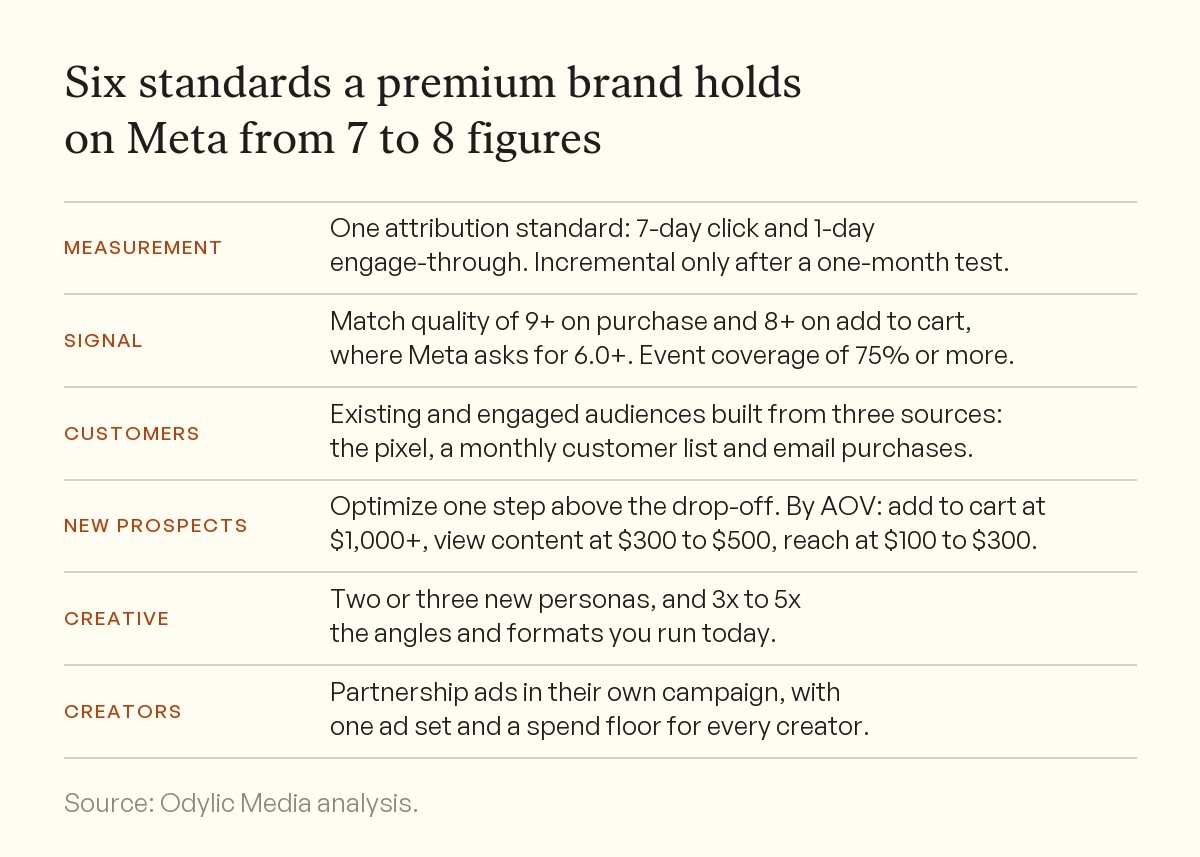
Most of what a premium brand needs at this stage fixes what Meta learns from, not the ads themselves.
I. Measurement comes first, and incremental is a test
Our paper on Meta attribution settings makes 7-day click, 1-day engage-through the standard for most brands. Incremental attribution, Meta's model of which sales its ads caused, suits long journeys with heavy data.
Many premium brands are the brands incremental was built for. It fits when the journey runs two to three weeks or more and AOV sits well above your niche. It also needs steady volume, and Meta's learning phase bar of about 50 conversions per ad set per week is a useful floor.
Premium brands pass the first two tests easily, and most of them fail the third. At a $1,000 AOV, 50 purchases a week in one ad set is $50,000 in weekly sales.
So we test incremental on one campaign that blends several SKUs, which gives the model more purchases than any single product could. Run it for one month, next to the campaign on your current setting.
Meta does not let you change a campaign's attribution model after you publish it (Meta). Build the test as a duplicate.
Judge it on store revenue and new customer MER, which is new customer revenue divided by the spend aimed at new customers. Do not compare it with old click ROAS. At the typical brand we checked, Meta's incremental model credited 68% of the revenue that 7-day click plus 1-day view reported.
Outside tests are mixed. In May 2026, Haus said incremental attribution had beaten standard settings in 43% of its lift tests. It called that not a home run yet, with a sample that is still small (Haus). Its tests also found that Meta's 7-day click under-reports what Meta ads cause by about 15%.
So the inflation in most reports comes from view credit, and the click standard sits closer to the truth.
Whichever setting wins, hold one standard. In our September 2026 tracking audit, almost every account mixed attribution settings across its live ad sets. Report each setting on its own row, and never average ROAS across them.
None of these settings help if the events behind them are wrong.
II. Signal quality sets the ceiling, and it breaks quietly
Every sale Meta optimizes toward, and every audience it builds, starts as an event on your site. If those events go missing, double up or match the wrong person, nothing downstream can fix it.
Event match quality is Meta's score, out of 10, for how well the customer information on your server events matches accounts on Meta. Meta scores it only on web events sent through the Conversions API (Meta for Developers).
Meta recommends 6.0 or higher, and says a higher score can lower your cost per action (Meta for Developers).
Our working targets are higher: 9 on purchase and 8 on add to cart. Meta publishes no targets by event, so treat these as ours.
They are within reach. A healthy account we managed ran the pixel and the Conversions API together, with duplicates removed. It scored 9.1 on purchase, 8.2 on add to cart and 7.5 on page view, since events higher in the funnel carry less customer information. An account we audited this year scored 4.8.
Watch event coverage too. That is the share of pixel events that also arrive through the Conversions API with matching deduplication keys. Meta's Dataset Quality API flags events below 75% coverage.
Fix it in order, starting with the standard setup. On Shopify, the Facebook and Instagram by Meta app sends events through the Conversions API at its Enhanced and Maximum levels (Shopify). Elsewhere, Meta's Conversions API Gateway does the job.
Then turn on automatic advanced matching and send the same event ID from browser and server. Pay for a tracking platform or an audit only if scores stay low.
Tracking rarely breaks loudly. In our September 2026 audit, every pixel in use had fired within the last day, so nothing looked down. The problems sat underneath:
One account ran its live pixel with advanced matching switched off.
One of the largest accounts split its live ad sets across two pixels, so neither pixel saw the whole picture.
At one brand, add to cart fired less than half as often as purchases. Landing page views came to about 18% of link clicks, against about 81% across the brands we manage.
In some accounts, purchases matched or beat checkouts started, because the checkout event missed express checkout.
One booking tool logged appointments as purchases, so Meta learned from sales that never happened.
Half the accounts still carried old pixels that had not fired in months, or ever.
None of these show up as an error in Ads Manager. Meta keeps optimizing on whatever arrives.
Expect reported results to rise after a fix, because better matching credits more sales to your ads. Set a new baseline two weeks later.
Clean events tell Meta who bought. The next standard decides who Meta is allowed to reach.
III. Customer definitions decide whether new budget finds new people
As spend grows, frequency and CPMs creep up. This happens sooner for a premium brand, because fewer people can buy at its price, as our paper on higher AOV and cheaper SKUs shows.
The first fix is airtight definitions of who already knows you. Build existing customer and engaged audiences from three sources. Use the pixel, a customer list you upload every month and email purchase events, such as Klaviyo's.
Our paper on the Q4 Meta account structure walks through the setup.
Loose definitions are expensive. In our study of ad concentration, campaigns named for prospecting sent only about 84% of their spend to people Meta classed as new. The rest reached people who already knew the brand.
Those people also cost more to reach. Inside the same ad, an engaged person cost 1.81 times as much as a new one. An existing customer cost 2.10 times as much, in Meta's audience data for July and August 2026.
The second fix is a dedicated upper funnel campaign, once the account needs one. The trigger is specific. Reach and new customer efficiency keep falling despite fresh creative and offers, while CPMs and frequency climb.
Our paper on net new reach shows the two numbers that reveal it first.
Pick the optimization event with one rule. Find the step where your funnel drops off, and optimize for the step one above it.
In our accounts, that usually lines up with AOV. At $1,000 and up, optimize for add to cart, because buyers take weeks and a cart signals strong intent. At $300 to $500, use view content or landing page views.
At $100 to $300, use reach or landing page views, because the funnel is short. Between $500 and $1,000, let your drop-off point decide.
Run an email capture campaign next to it, with an offer worth an email address. Good offers are a free gift with signup, VIP early access, a membership perk or a giveaway entry. A 10% code rarely is.
For high AOV brands, it is one of the most underused plays at seven figures. A buyer who takes weeks to decide stays reachable on your list.
Wider reach still needs something new to show the people it finds.
IV. Creative supply has to grow faster than budget
A brand can reach seven figures with one persona, a handful of angles and two or three formats. In our experience, eight figures takes two or three new personas, plus 3x to 5x the angles and formats you run today.
Winners do not last long enough to carry the extra budget. In the same study, the top ad kept its spot into the next month only 30% of the time.
More copies of the winner will not fill the gap, because Meta treats look-alike ads as one creative. Our paper on the creative diversity grid shows how to count distinct ideas. Meta now rates each ad set's creative diversity as High, Medium or Low.
Tag every ad by format, medium, production style, angle, persona and placement, so gaps show before you brief. Our paper on creative tracking covers the system. Look outside your niche for formats, such as founder-led content, listicles and brand films.
For fashion and jewelry, most new angles are new SKUs, styles and colorways, as our paper on premium fashion SKU testing explains.
Give each new persona its own campaign and budget. Our paper on how Meta overfits your account shows how new ideas starve next to proven winners.
Partnership ads deserve a bigger share at this stage. The typical brand we manage that runs them put 11% of its spend into them over the last year, and the heaviest put 45%. They did not cost less per sale, but they stayed live 1.89 times as long as other ads.
Pick creators who match your most profitable buyer and make content that works as an ad. Our paper on partnership ads campaign structure covers the setup: one campaign, with one ad set and a spend floor for each creator.
Each of these standards costs little next to the budget it protects, so the order matters.
V. Hold the standards before you raise the budget
1. Write down the attribution setting on every live ad set. Move the account to 7-day click and 1-day engage-through, and report any other setting on its own row.
2. Test incremental only with a journey of two to three weeks or more and AOV well above your niche. You also need about 50 purchases a week per ad set. Run it for one month on a duplicate of a blended, multi-SKU campaign.
3. Check event match quality for each event in Events Manager. Aim for 9 or higher on purchase and 8 or higher on add to cart, and treat anything under 6.0 as broken. Keep event coverage at 75% or more.
4. Fix tracking in order: the standard Conversions API setup, automatic advanced matching, then matching event IDs. Put every live ad set on one pixel, and set a new baseline two weeks after the fix.
5. Check the funnel every week. If add to cart fires less often than checkouts, or checkouts less often than purchases, check the tracking before you touch the ads.
6. Rebuild existing customers and engaged audiences from the pixel, a monthly customer list and email purchase events.
7. Add an upper funnel campaign once new customer efficiency falls despite fresh creative. Optimize one step above your drop-off, with an email capture campaign beside it.
8. Plan two or three new personas for the next two quarters, with 3x to 5x today's angles and formats. Move more budget into partnership ads.
The brands in our opening tried to spend their way past seven figures on the setup that got them there. The ones that reach eight figures fix what Meta learns from first, and then they spend.
On Monday, open Events Manager and write down the match quality score for purchase and add to cart. We still do not know what each point of match quality is worth in cost per purchase, because Meta publishes no curve. Incremental attribution is also young, and the evidence on it will keep changing as lift tests come in.
About this research
This paper draws on the Meta accounts we manage and audit, including a September 2026 audit of pixels, events and settings. It also uses our 2025 to 2026 studies of spend, reach and creative. The score targets and AOV ranges are working rules from our account work, not a controlled test.
See what this means for your account.
A complimentary growth session, built around your account and your numbers.

Meta Algorithm
Meta Picks Your Winner in 72 Hours, on One Purchase
At 72 hours, the ad Meta goes on to fund has a median of one purchase, and 37% have zero. More data does not make Meta's pick more profitable.

Meta Algorithm
Meta Does Not Push More Spend to Your Higher-Engagement Ads
Across the brands we manage, engagement explains 0.07% of where Meta puts spend, and a jump in likes buys no extra budget the next day. Meta funds sales.

Creative
A Few Ads Carry Every Meta Account. Your Best Ad Fades in 90 Days
The top 10% of Meta ads take 64% of a typical month's spend, and that is normal. The risk is turnover: your #1 ad fades within three months.