

Account Structure

Peter Quadrel
9 min read
The best Q4 Meta account structure is the year-round build plus three holiday campaigns. CPMs ran 51% above October at Black Friday, so build it now.
Most brands treat Q4 as a reason to rebuild their Meta account. New campaigns go up for every promo. Settings change in the week of Black Friday, and budgets jump overnight.
That rebuild lands at the worst time. Every new campaign starts learning from zero, in the most expensive weeks of the year. Across the brands we manage, CPMs from Thanksgiving to Cyber Monday 2025 ran a median 51% above October.
Many brands also never check the settings that decide where the money goes. Audience Network stays on, past buyers leak into prospecting, and Meta tests new AI features on their ads.
So what should a Meta account look like going into Q4, and what has to be fixed first?
The best Q4 Meta account structure is the year-round build plus three holiday campaigns. You set it up in October, after you fix four account settings.
Here is what we found. The year-round build does most of the Q4 work, and October is the cheapest month to buy reach. Three campaigns cover the holidays, four settings decide where the money goes, and profit bidding has to start now.
I. The year-round build does most of the Q4 work
A good Q4 account is the same account you run in March, with as few changes as possible. The build has four year-round campaigns, and Q4 adds three more.
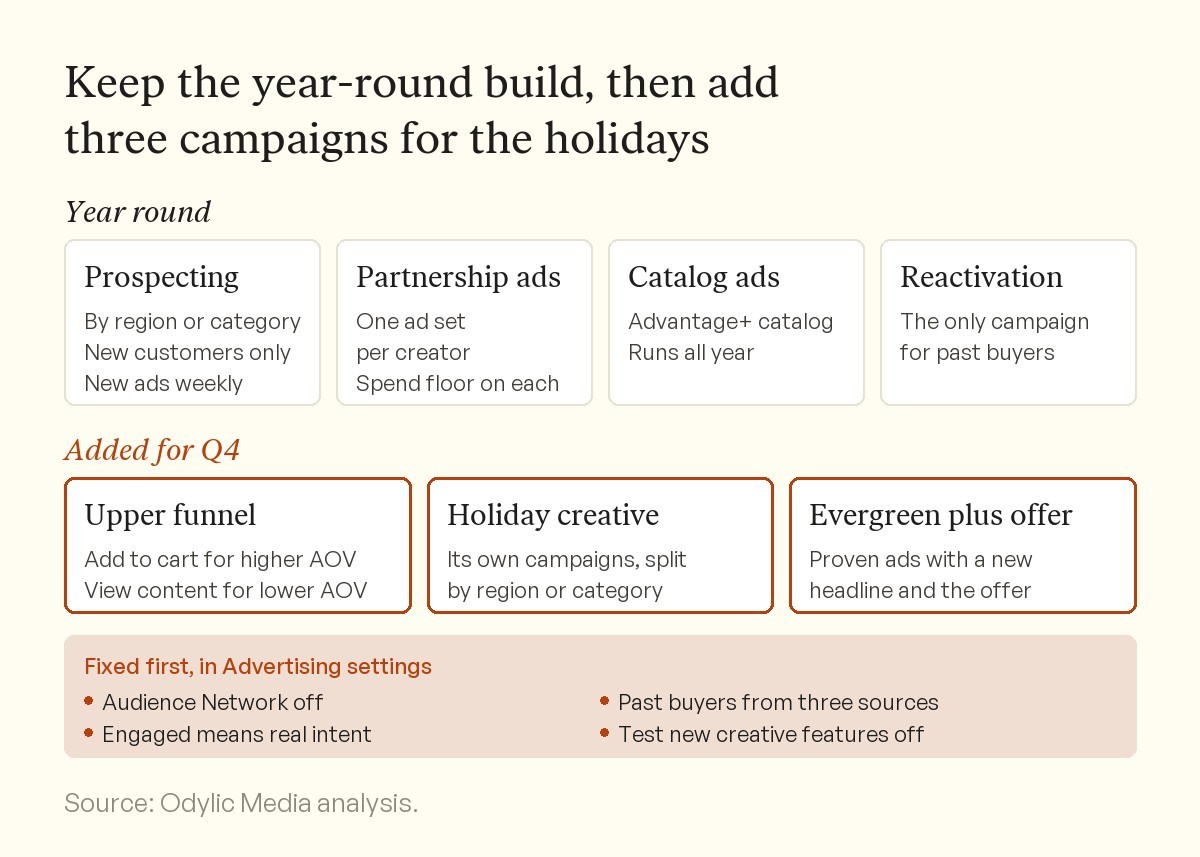
Most of a Q4 account is the year-round build. The holidays add three campaigns, and the account settings come first.
Prospecting runs as one campaign per region or product category. Each uses the Sales objective and Advantage+ campaign budget, Meta's current name for CBO.
In each ad set, we set Meta's customer lifecycle strategy to Acquire new customers, so the budget stays on people who have never bought (Meta). Meta warns this can raise cost per result and suggests judging it on new customer CPA from your own tools.
New ads launch every week as their own ad set, on the Highest volume bid strategy. That is what Meta used to call lowest cost.
The separate ad set keeps the rest of the campaign stable. Meta counts adding a new ad to an ad set as a significant edit, which restarts learning. Adding a new ad set to a campaign on Advantage+ campaign budget leaves the other ad sets alone (Meta, Significant edits).
Each new batch gets a minimum spend for 7 to 14 days through ad set spend limits. Then we remove it, and Meta allocates on its own.
That window fits our study of how Meta picks a winning ad. There, 56% of late lead changes had happened by day 7, and 79% by day 14. The floor protects the new batch from old winners, and Meta still picks the winner inside it.
Attribution follows our paper on Meta attribution settings. Brands with long buying journeys, high AOV and steady weekly purchases run incremental attribution. Smaller, lower AOV or video-heavy brands run 7-day click, 1-day engage-through.
Decide this before you build the Q4 campaigns. Meta does not let you change the attribution model after you publish (Meta).
The other three campaigns each do one job. Partnership ads get their own campaign with one ad set per creator, as in our partnership ads campaign structure. Advantage+ catalog ads, Meta's name for dynamic product ads, run all year.
Reactivation is the only campaign allowed to reach existing customers. Every other campaign excludes them.
Most accounts we check have no reactivation lane at all. When we sorted ads by who Meta actually showed them to, the median account had no ad that mainly reached existing customers.
So if the build stays the same in Q4, what changes? The main change is the price of reach.
II. October is the cheapest month of Q4 to buy reach
We compared daily Meta data from October 2025 with the rest of that quarter, brand by brand, across the DTC brands we manage.
CPMs rose as soon as October ended. From November 1 to 26, the median brand paid 12% more per 1,000 impressions than in October.
The five days from Thanksgiving to Cyber Monday cost the most. CPMs ran a median 51% above October, while brands spent 3.7 times as much per day.
Early December stayed expensive. From December 2 to 20, CPMs ran 23% above October. Most brands paid more in each of those windows.
Those five days also converted far better. Purchases per link click ran 1.79 times the October rate, in almost every brand.
So October buys attention at the lowest price of the quarter, and the holiday weeks turn it into sales. That is why we put October budget into new reach. The people you reach in October become the warm audience that buys in November and December.
It is also why we launch Q4 campaigns in October. A campaign launched in late November starts learning at peak prices.
One holiday season is a small base, and some of the CPM rise comes from brands' own bigger budgets. The direction still held in most brands.
So what should the account add for November and December?
III. Three campaigns cover the holidays
The first Q4 campaign is an upper funnel campaign, on nearly every account. It uses the Sales objective but optimizes for an earlier event. Higher AOV brands optimize for add to cart or similar, and lower AOV brands for view content or similar.
It builds the warm pool cheaply in October, and it gives Meta far more events to learn from than purchases alone.
The second is a set of holiday campaigns for big seasonal creative. They are split by region or product category, like prospecting.
Holiday creative needs its own budget. Inside the evergreen campaign, a new holiday concept fights winners with months of purchase data and often loses before it gets a fair test. Our paper on how Meta overfits your account shows how new ideas starve that way.
The third is evergreen with the offer. The proven evergreen ads keep running as they are. Next to them, we launch copies in a new ad set, with a new headline and the offer added.
We use copies because Meta counts any change to ad creative as a significant edit. Editing a live winner to add the offer would send its ad set back into learning. The copies carry the offer, and the originals keep their data.
None of this helps if the account sends money to the wrong people. That is set one level up, in Advertising settings.
IV. Four account settings decide where Q4 money goes
Advertising settings in Ads Manager apply to the whole account. Four of them take a few minutes and shape every Q4 campaign.
The first is placement controls. Turn on "My business can only advertise on specific placements" and uncheck Audience Network (Meta). Uncheck Facebook Marketplace too, unless you sell a cheaper impulse product. Pull your placement breakdown first, and turn off whatever has not worked for you.
This setting matters more this year. Since late August 2026, Meta has been removing placement exclusions at the ad set level (Common Thread Collective). The account setting is now the only way to switch a placement off, and Meta says it can take 48 hours to apply.
The second is existing customers, under Audience segments (Meta). Build it from three stacked sources. Use an all-time purchaser list upload, a purchaser audience synced from Klaviyo, and the pixel purchase event on the longest window Meta offers. One source alone will leak.
This definition powers Acquire new customers and your exclusions, and leaks are costly. Within the same ad, reaching an engaged person cost 1.81 times as much as reaching a new one. Reaching an existing customer cost 2.10 times as much. Both held in every account we checked.
The third is your engaged audience. Decide what engaged means for your brand, because an Instagram like and a two-minute product page visit are not worth the same.
High AOV brands should require real intent, such as a view content or an add to cart over 30 to 90 days. Low AOV brands can go lighter, over 14 to 30 days. With Acquire new customers on, you can also exclude engaged audiences, so a loose definition shrinks prospecting for no reason.
The fourth is Test new creative features, under Creating ads and then Creative features. Uncheck it. When it is on, Meta can apply creative features still in testing to your campaigns (Meta).
That means Meta runs AI experiments on your ads, under your brand. If your account lists the test features one by one, we keep only translation, comment keywords and image touch-ups. We also turn off most Advantage+ creative enhancements on each ad.
The next decision is new this year, and it takes the longest to set up.
V. Profit bidding has to start in October to be ready
Revenue bidding treats every dollar of revenue the same. A $200 sale at 15% margin and a $200 sale at 60% margin look identical to Meta, and you pay the same to win both.
Meta now offers another option. In a Sales ad set, choose Maximize value of conversions, then set the conversion value to Purchase profit (Meta).
The wider your margin spread, the more this matters. Take a $95 accessory at 70% margin and a $600 hero piece at 30%. Revenue bidding values the hero order at 6.3 times the accessory. Profit bidding values it at 2.7 times.
Meta still buys the hero order, but small high-margin products stop starving for being cheap.
Here is how we build it. Fill in cost per item on every product variant in Shopify. On each purchase, look up that cost for every line item, since one order can mix margins. Then send subtotal minus discount minus cost as net_revenue on the Purchase event.
Meta asks for at least 3 distinct positive profit values. Your profit values also cannot just mirror revenue, as they would if every order earned the same margin. Meta suggests a budget that covers at least 100 conversions a week (Meta), and not every account has the option yet.
Timing is the catch. Meta says the integration takes about a week, and it recommends tests of at least three weeks. Start this week, and your first test ends in early November.
pLTV, or predicted lifetime value, goes one step further. You send Meta your own prediction of each new customer's long-term value. Meta can then pay more for the buyer whose first order turns into three more at full price.
It is harder to qualify for. Meta asks for at least 100 conversions a week attributed to Meta, for each of the last 4 weeks. You need at least 5 distinct positive predicted values, with the highest at least 3 times the lowest. Your dataset also cannot be in Core Setup (Meta for Developers).
You can send the prediction inside the purchase event, or within 7 days as an AppendValue event. Meta says sending it faster does not currently help. Meta also asks for about 2 weeks of model training (Meta), so with a three-week test, a start this week runs into mid-November.
Both options are only as good as their inputs. Leave cost per item blank across half the catalog, and profit bidding bids on wrong numbers.
VI. Build the Q4 account in October, then leave it alone
1. Open Advertising settings this week. Turn on "My business can only advertise on specific placements", uncheck Audience Network, and uncheck Facebook Marketplace unless you sell a cheaper impulse product.
2. Define existing customers from an all-time purchaser list, your Klaviyo purchasers and the pixel purchase event. Define engaged as view content or add to cart over 30 to 90 days for high AOV, or 14 to 30 days for low AOV.
3. Uncheck Test new creative features, and turn off most Advantage+ creative enhancements on your ads.
4. Pick each campaign's attribution model before you build it, because Meta will not let you change it after you publish.
5. Run prospecting as one campaign per region or category, with Acquire new customers on. Launch new ads weekly as their own ad set on Highest volume, with a minimum spend for 7 to 14 days.
6. Launch the upper funnel campaign in October, on add to cart for high AOV or view content for low AOV.
7. Give holiday creative its own campaigns. Add the offer through copies of evergreen ads in a new ad set, not by editing live winners.
8. Start profit or pLTV setup by mid-October to have it live for Black Friday. Fill in cost per item across the whole catalog first.
9. Judge Q4 on new customer numbers from your own tools, not on campaign CPA.
Most brands treat Q4 as a rebuild that starts in November. We build in October, while reach is cheap, and leave the account alone once prices climb.
On Monday, open Advertising settings and fix the four settings. Profit bidding is still new, and we have not yet seen how it holds up through a Black Friday week.
About this research
The Q4 figures compare October 2025 with November and early December 2025, brand by brand, across DTC ad accounts we manage. Reach costs come from Meta's audience segment data for July and August 2026, and every setting was checked against Meta's help center in October 2026. The main limit is that the Q4 figures cover one holiday season, and the conversion rates leave out an account that tracked bookings as purchases.
See what this means for your account.
A complimentary growth session, built around your account and your numbers.

Meta Algorithm
Meta Picks Your Winner in 72 Hours, on One Purchase
At 72 hours, the ad Meta goes on to fund has a median of one purchase, and 37% have zero. More data does not make Meta's pick more profitable.

Meta Algorithm
Meta Does Not Push More Spend to Your Higher-Engagement Ads
Across the brands we manage, engagement explains 0.07% of where Meta puts spend, and a jump in likes buys no extra budget the next day. Meta funds sales.

Creative
A Few Ads Carry Every Meta Account. Your Best Ad Fades in 90 Days
The top 10% of Meta ads take 64% of a typical month's spend, and that is normal. The risk is turnover: your #1 ad fades within three months.