

Creative

Peter Quadrel
9 min read
55% of active Meta ads get zero purchases in a month. How to tag every ad, put the tags in the ad name and read Meta creative tests by variable.
Most brands read their creative tests one ad at a time. They sort Ads Manager by ROAS, find the winner and ask the designer for more like it.
That read breaks down fast. In a typical month, 55% of a brand's active Meta ads record zero purchases. A single ad rarely has enough sales to tell you which idea worked.
The cost shows up when results slip. Nobody can say what changed in last week's launches, because the ad names mean nothing.
So we asked how a team can learn from creative when most single ads are too small to judge.
The answer is a tracking system. Tag every ad with the variables that make it different and carry the tags in the ad name. Then read results by variable, across many ads at once.
Here is what we found. Single ads are too small to judge, so a tagging sheet has to make variables countable. A keyed ad name carries them into Meta. Then you add results up by variable, compare like with like and read them on a fixed schedule.
Here is one ad in that system. Its name is AB00231N916261007-PR:Carry On-PE:Weekend Traveler-AN:No Checked Bag-CN:Gate Sprint-FO:Video-PS:UGC-HK:Question-FP:TOF. The ID up front says this is ad 00231, a net new concept, cut at 9:16 and made on October 7, 2026. Each key after it names one variable.
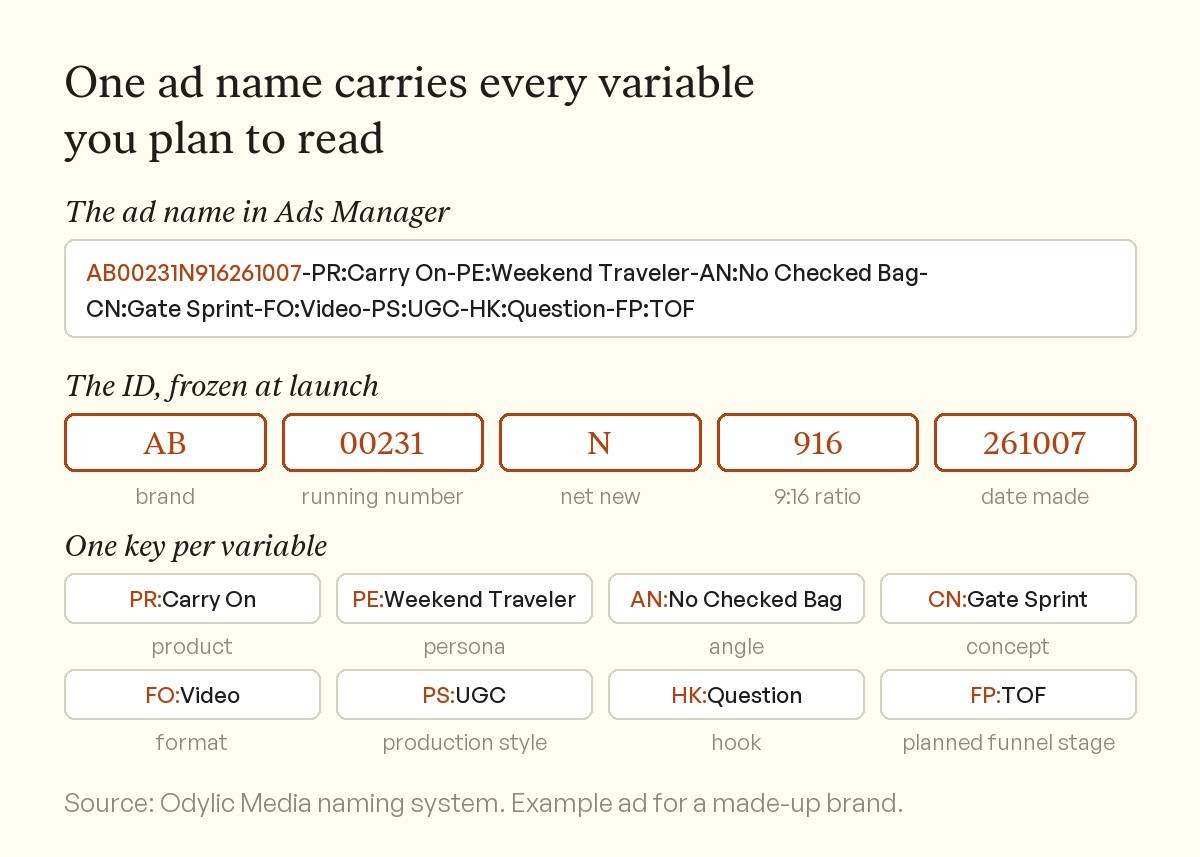
Anyone can read the test from the name, and a formula can add up every ad that shares a key.
I. Most single ads are too small to judge
Start with how little data one ad gets. In our study of how a few ads carry every Meta account, 55% of active ads recorded zero purchases in a typical month. More than half spent under $100 all month, and one in five spent under $10.
Meta makes its choice on almost nothing. At 72 hours, the ad Meta went on to fund had a median of one purchase. Our paper on how Meta picks a winner in 72 hours covers that study.
Early wins do not hold either. Ads that beat the leader's ROAS over days 3 to 13 did it again over days 14 to 29 only 51% of the time.
Many ads never get a test at all. In our study of ad volume, 33% of new ads got less than $50 in their first 30 days, even in a team's quietest months. In its busiest months, 42% to 45% did.
So an ad with two purchases is not better than an ad with zero in any way you can trust. A variable is a better unit of learning. One angle might run across a dozen ads, three formats and two months. Add those ads together, and you have enough sales to see a difference.
That only works if every ad carries the same labels, written the same way. So which labels should you track?
II. Tag the variables that make one ad different
The variables we track fall into five groups.
What you sell: product, category, collection and offer.
Who it speaks to and why: persona, the emotion that moves that persona, the angle and the concept.
How it looks: format, production style, production quality, text overlay and aspect ratio. Video ads also get a hook, a body and a call to action.
Where and when: the seasonal moment, the funnel stage you planned and the landing page.
Where it came from: net new or iteration, plus the iteration seed and branch.
The angle is the sales argument, and the concept is how the ad shows it on screen. Keep them separate, because one angle can run in many concepts.
The seed is the ID of the ad that started an iteration chain, and the branch is the ad this version is built from. Together they show which branch of a winning idea kept winning.
In our experience, most brands share about 80% of this list. The other 20% is your niche, such as fit and fabric for apparel.
Build the sheet with four rules.
Make every field a dropdown, fed from one tab that holds every allowed value. Free text leads to typos, and every typo becomes a new value. "Carry-On", "Carry On" and "carryon" would show up as three products in every report.
Make the fields you plan to read required. Optional fields get skipped, and a variable with gaps cannot be added up.
Tag at brief time, before launch. Write the hypothesis in the same row, then write what happened after the ad runs.
Log the date of every status change, from in progress through review, approval, live and paused. Those dates show where the pipeline gets stuck.
Logging takes about two minutes per creative. An image model can fill in most dropdowns, and a strategist checks them.
A sheet full of tags still lives outside Meta. So how do the tags get into the ad account?
III. Put the tags in the ad name, one key per variable
The ad name is the one field that travels with every ad. It shows up in Ads Manager, exports and the API, and URL parameters carry it into your analytics.
Generate every name with a formula from the sheet. Nobody types an ad name by hand.
Give every value a key. "AN:No Checked Bag" is the angle wherever it sits in the name. A name built on position breaks as soon as one field is blank, because everything after it shifts. When we moved to keys in September 2026, a parser could not reliably read many of our older position-based names.
Keys also make search exact. Meta's Ads Reporting lets you search by ad name (Meta, Search and filter by creative). A search for "FO:Video" finds the video ads and skips a concept that happens to use the word.
Reserve two characters. We use a dash between fields and a colon between each key and its value. The formula turns either one into a space inside a value, so "Carry-On" reads "Carry On".
Meta's own name templates follow the same rule, with one template per level per ad account (Meta, Create a name template). They are a fair start, but they cannot hold a hypothesis or a result.
Put a unique ID first, and freeze it at launch. Ours carries a brand code, a running number, a net new or iteration letter, the ratio and a date. Write the date year first, so IDs sort by date.
We learned to freeze it the hard way. Our ID included a review date, so it changed when that date was stamped, and lookups on the old ID broke. Now the ID freezes once the ad is named.
Get the name right before you publish. Meta's name-based URL parameters keep the name an ad had when it was first published, even after a rename (Meta, URL dynamic parameters). Meta also warns that changing URL parameters after launch can send the ad set back into learning.
Join your data on Meta's ad ID, not the name. Record it next to your own ID on launch day. Names can be edited and copied, but the ad ID never changes. Add {{ad.id}} to your URL parameters so store and analytics data join on it too.
Keep one concept, angle and persona per ad. Flexible format puts up to 10 images and videos into one ad, and Meta picks what to show (Meta, Flexible ad format). In our experience, its reporting does not show which image or video made the sale. An ad with ten concepts has ten sets of tags and one result.
The same goes for Advantage+ creative enhancements that change your image, text or music (Meta, About Advantage+ creative). Turn off the ones that change what you tagged.
Meta's own reports do not replace the tags. Its ad creative breakdown and its Creative diversity label read your images and text, not your persona or angle.
Once every ad carries its variables, results can be added up. How you add them matters.
IV. Add results up by variable, and compare like with like
Pull spend, purchases and revenue for every ad into the sheet each day, on a 24-hour lookback. Add new-customer purchases from Meta's audience segments breakdown or your attribution tool. Keep every pull. Meta keeps total values for up to 37 months, and after that your copy is the only history (Meta for Developers).
Add first, then divide. For each value, sum spend, purchases and revenue across its ads, then work out ROAS or cost per purchase. Never average each ad's ROAS, or a tiny ad with one lucky sale counts as much as your biggest ad.
Count only the ads that got a real test. We call an ad fed if it spent at least $50 in its first 30 days, the line from our volume study. An angle whose ads all starved has not lost. It has not been tested.
Read two numbers for each value. The share of its ads that Meta fed shows what Meta expects to convert. Cost per new customer across the fed ads is your profit check. Our paper on planning creative on a grid judges a new persona the same way.
Compare values inside the same audience, because warm audiences flatter every variable. In the typical account we manage, the biggest ads showed 1.62 ROAS on new people and 3.07 on past buyers. A persona that ran mostly to past buyers will win on ROAS every time. Our paper on why you should almost never turn off an ad has those numbers.
Treat your funnel tag as a plan, not a fact. In our concentration study, campaigns named for prospecting sent 84% of their spend to prospecting. Campaigns named for retargeting still sent most of theirs to new people. Read the real stage from Meta's audience segments breakdown (Meta, Audience segments).
Compare values inside the same weeks. Across the brands we manage, CPMs from Thanksgiving to Cyber Monday 2025 ran a median 51% above October, as our Q4 account structure paper shows. A format that ran mostly in that window will look worse than it is.
Read the mix as well as the results. Track the share of spend on each product, persona, angle and format against your plan. Track net new against iteration, and how many ads go live each week.
The mix is where diagnosis gets fast. When results slip, filter the sheet to ads set live in the last seven days and compare them with the weeks before. You might find a move to studio shoots after weeks of low-fi content. You might find one category taking the budget, the same two angles recycled or new landing pages.
In our experience, that check takes minutes instead of days. The log also outlives the team, so a new strategist inherits every test and its result. It gives an AI model the briefs, hypotheses and results it needs to suggest the next test.
These numbers only help if someone reads them on a schedule and acts on them.
V. Read on a fixed schedule, and decide by variable
Each read has its own clock, because each question needs a different amount of data.
The daily pull runs on its own, and nobody decides anything from one day. On any given day, only 30% of a month's active ads spend at least $1.
At 72 hours and again on day 7, read the spend split on each new launch. That is a launch read, not a variable read.
Every week, read the mix: what went live in the last seven days, by variable, and how long each creative sat in each status.
Every month, read the variables on a 30-day window. The top ad changes about every seven weeks, so a month shows a pattern while there is time to act. Give a new persona 30 to 90 days, as our paper on how Meta overfits your account explains.
These are the moves we use.
1. Pick your variables from the five groups. Keep only the ones you will read, and make each one a required dropdown.
2. Generate every ad name with a formula: a frozen, unique ID first, then one key per variable.
3. Record Meta's ad ID next to yours on launch day, join all results on it, and add {{ad.id}} to your URL parameters.
4. Keep one concept, angle and persona per ad, and turn off enhancements that change what you tagged.
5. Pull spend, purchases and revenue into the sheet every day, and keep every pull.
6. Add up before you divide. For each value, report the share of its ads that spent $50 in their first 30 days. Then report its cost per new customer across those ads.
7. Compare values inside the same audience and the same weeks, and check the funnel tag against the audience segments breakdown.
8. Write the hypothesis before launch and the analysis after the monthly read. Brief more of a value that wins across many fed ads, and stop briefing one only when it loses across them.
The brand that sorts Ads Manager by ROAS every morning is mostly reading noise. On Monday, add three keys to every new ad name: persona, angle and format. In a month you will have your first read by variable.
We have not measured how much a tracking system lifts results. Meta also does not show how it groups your ads, so this method rests on our own account experience.
About this research
This paper describes the creative tracking system we use with the brands we manage. It draws on our 2025 to 2026 studies of spend concentration, launch volume, audience segments and how Meta picks a winner. The variable list, the $50 line and the reading schedule are our working method, not the result of a controlled test.
See what this means for your account.
A complimentary growth session, built around your account and your numbers.

Meta Algorithm
Meta Picks Your Winner in 72 Hours, on One Purchase
At 72 hours, the ad Meta goes on to fund has a median of one purchase, and 37% have zero. More data does not make Meta's pick more profitable.

Meta Algorithm
Meta Does Not Push More Spend to Your Higher-Engagement Ads
Across the brands we manage, engagement explains 0.07% of where Meta puts spend, and a jump in likes buys no extra budget the next day. Meta funds sales.

Creative
A Few Ads Carry Every Meta Account. Your Best Ad Fades in 90 Days
The top 10% of Meta ads take 64% of a typical month's spend, and that is normal. The risk is turnover: your #1 ad fades within three months.