

Creative

Peter Quadrel
8 min read
Meta now scores creative diversity per ad set and treats look-alike ads as one creative. Why 40 variants fill one cell, and how to plan a 576-cell grid.
Most brands count their creative in ads. They run forty at once, add twenty a week and keep a dozen versions of the winner.
Most of those versions are the same ad. The team swaps the headline, the background or the first two seconds, and calls each one a new test.
Meta does not count them that way. Its system groups ads that look and feel alike and treats them as versions of one creative. Ads Manager now also rates each ad set's creative diversity as High, Medium or Low.
That gap costs money. You pay to make forty ads, and Meta reads them as one idea, sends them after the same people and never funds most of them.
So we asked how many of your ads Meta treats as different, and how to plan creative so each new ad can reach someone new.
The answer is simple. Meta treats look-alike ads as one creative, so count distinct ideas instead of ads, and plan them on a grid of angle, format and persona.
Here is what we found. Meta groups look-alike ads and now scores your ad sets on it. Extra copies starve instead of finding new buyers. A grid gives each ad its own place to win, and persona is the axis that reaches new buyers.
Picture a grid with 12 angles down the side and 12 formats across the top. Four personas stack it four deep, into 576 cells. Forty variants of one winner fill just one of them.
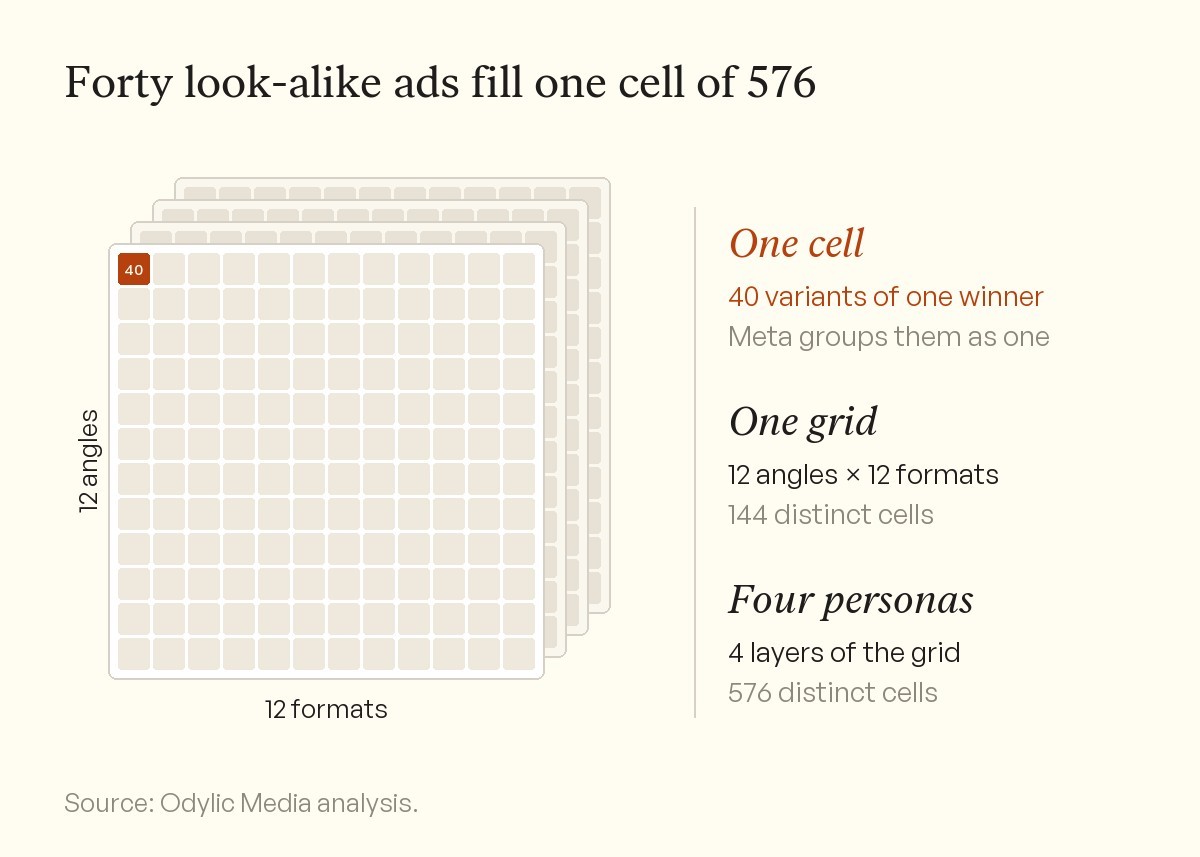
Forty versions of one winner are one test. The grid shows how many distinct tests there are to run.
I. Meta treats look-alike ads as one creative
Meta has said this in plain terms. In December 2025, it wrote that its ads system "groups together ads that share key visual and thematic attributes" (Meta, Demystifying creative diversification).
Meta sees those ads as versions of the same creative. It shares learning and delivery across the group, not just ad by ad.
The sorting starts before the auction. Meta's retrieval system, Andromeda, scans tens of millions of ads and picks a few thousand candidates for each person (Meta Engineering, Andromeda). Meta says only the most relevant and distinct creatives move forward.
A simple way to picture this is a map. Every ad and every person sits somewhere on it, and similar things sit close together. When someone opens Instagram, Meta pulls the ads that sit near that person.
Ten versions of one ad sit in the same spot on that map. So they reach the same people ten times.
Meta draws a clear line between iteration and diversification. Iteration gives you two ads with the same visual and a different call to action. Diversification gives you distinct ads built for different personas or use cases. Meta's own example is a Reels ad made for Gen Z next to a partnership ad with a creator who connects with new moms.
Now Meta scores the difference. Its Creative diversity metric labels an ad set, or a whole account, High, Medium or Low (Meta Business Help Center).
Meta builds the label by comparing the images and video thumbnails in the ad set to each other. It calls the metric estimated and still in development.
Two details matter. The label only reads images and thumbnails, so a new headline on the same picture does nothing for it. And Meta has not said that the label changes delivery, so treat it as a flag, not a verdict.
Meta has not published how different two ads must be. Our rule of thumb is that most of the frame has to change, about 70% of the pixels. In our experience, when only the headline or background changes, Meta tests one ad and applies what it learns to the rest.
So what happens to the other versions?
II. Extra copies starve instead of finding new buyers
A brand we work with had one format that worked. Every other format lost. The pixel only had purchase data on that one look, and it starved anything unfamiliar before it could earn its first 20 purchases.
Across the accounts we manage, delivery is just as narrow. In the typical month, the budget behaved as if it were split evenly across only 15% of the live ads.
Adding ads barely moves that. When an account doubled its live ads, the number of ads that got real spend rose only about 40%. Our paper on how a few ads carry every Meta account shows why that shape is normal.
Launching more does not fix it either. In our study of ad volume, doubling the new ads launched in a month produced about 47% more winners, not twice as many. Each doubling cut a given ad's odds of becoming a winner by about 30%.
The cause was starvation, not weaker ads. In the months a team launched the least, 33% of new ads got less than $50 in their first 30 days. In the months it launched the most, 42% to 45% did.
Most of that volume only keeps the account where it is. In the typical account, the number of ads that stopped spending each month equaled 95% of the number it launched.
Our data cannot show how many starved ads were copies of a winner. Meta's grouping gives a likely reason, though. A copy joins the group of the ad it copies and chases the same people. It has little room to earn spend of its own.
We see where this ends in audits. In the supplement account from our paper on overfitting, one static line had reached version 448. Its recent versions got $1 to $8 of spend each.
This is why creative volume has become a vanity metric. Forty ads that Meta reads as one idea cost you forty briefs and buy you one test.
So how do you plan forty ads that Meta reads as forty ideas?
III. A grid gives each ad its own place to win
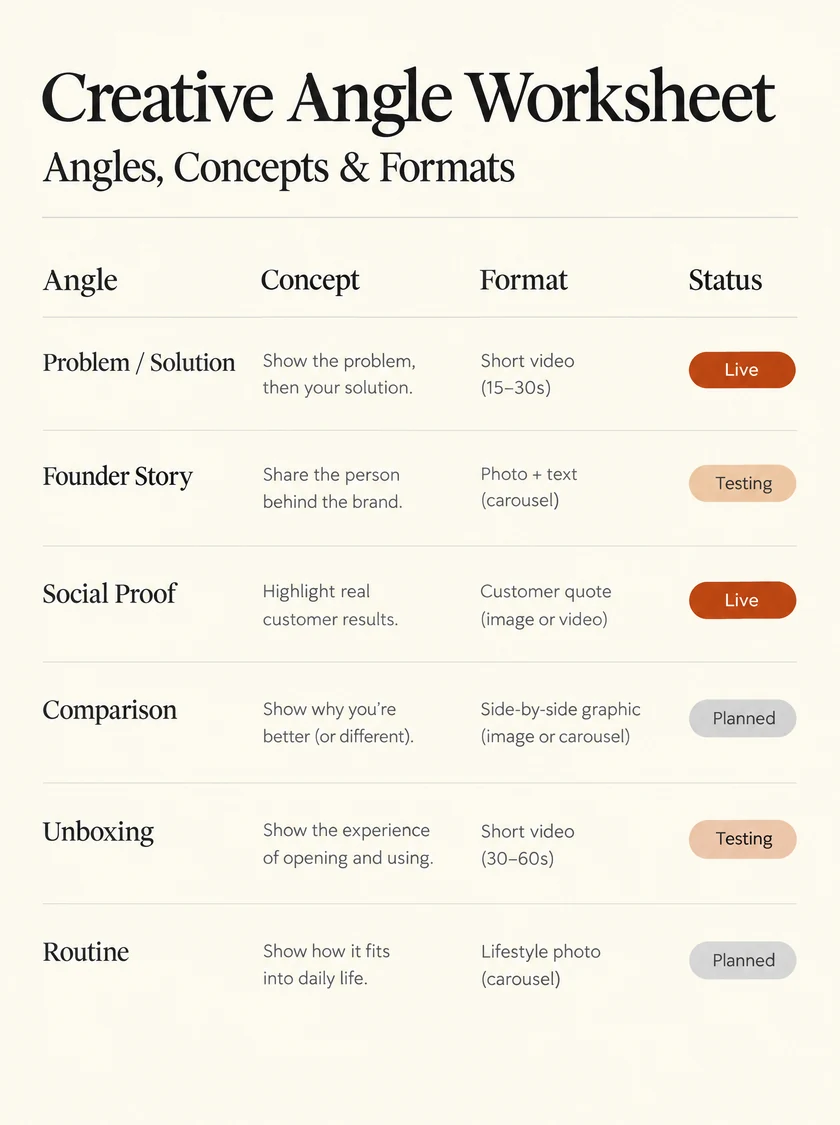
We plan creative on a grid. Angles run down the side and formats run across the top. A full grid of 12 angles and 12 formats has 144 cells.
An angle is the reason to buy and the person it speaks to. A format is the shape and look of the ad. Examples are a UGC selfie video, a product hero static, a carousel, a founder talking head and a meme. Together they cover the three things Meta names: visuals, messaging and format.
Every cell is a one-line brief that a designer, a creator or an AI image model can make. Every cell is its own test, with its own clock.
Launch a full row at once. Meta picks the ad it will fund in about 72 hours, as our study of how Meta picks a winner in 72 hours shows. Launch one angle across every format on Monday, and by Thursday you know which formats carry it. One scattered cell tells you nothing.
Fill across before down. A proven angle in a new format is the cheapest test in the account, because the message already sells. A new angle in a new format costs more, but it is the test most likely to reach people the account has never bought.
Judge rows and columns, not single ads, and judge them on cost per purchase. Spend share inside a launch mostly shows what the pixel already knows. Likes and hook rate show even less, as our study of engagement and spend found.
Expect columns to wear out at different speeds. In our study of ad lifespan, video ads outlived image ads by about a week inside the same ad set. The median video ran 50 days, against 43 for images.
Retire a row when it loses in every format, and a column when it loses in every angle. Keep the winning cell live while you build around it.
Meta's fatigue guidance points the same way. When it flags creative fatigue, it suggests a new ad with a materially different image or video. It also notes that keeping the original ad live may get you more results (Meta Business Help Center, Creative fatigue).
A full grid still speaks to one kind of buyer. So what happens when it fills?
IV. Persona is the axis that reaches new buyers
Twelve angles aimed at one persona still land near the same people. Change the persona, and an angle you already run can reach a pool the account has never touched.
So persona becomes the third axis. Four personas stack the 144-cell grid four deep, into 576 cells. We call this the cascade. Persona picks the layer, angle picks the row and format picks the column.
That is why Meta defines diversification by persona. It says ads built for different personas help advertisers reach new audiences.
In our experience, a new angle moves cost per purchase a few points. A new persona changes who the pixel can buy at all.
Write the persona before the angle. A dad who is up at 3am and a founder who cannot switch off buy the same sleep aid for different reasons. Each one needs a different first line, a different face and a different setting.
Launch a new persona as at least a full row across formats. One cell for a new persona is noise. A full row gives Meta enough to place the persona inside 72 hours.
Judge a layer first on whether Meta will spend on it, then on new-customer CPA. Personas will not all earn the same profit or have the same room to grow, so price that in before you compare them.
Keep one thread running through every layer. Each persona should get ads that look different and speak to a different person, and every ad should still read as your brand.
When four personas fill, the next step is a new customer segment with its own grid. Every cell is still a one-line brief.
V. Brief by cell, and count cells instead of ads
The goal is more distinct tests, not more ads. These are the moves we use.
1. Add Meta's Creative diversity metric to your Ads Manager columns. Open your biggest campaign and count the ad sets rated Low before you brief next week's batch. Treat Low as a flag, because Meta still calls the metric estimated.
2. Give the Low ad sets the most variety in the next batch. Change the visual, the message and the format. A new headline on the same image is iteration, and Meta counts it that way.
3. Change most of the frame. Our rule of thumb is about 70% of the pixels. If two ads would pass for each other at a glance in the feed, count them as one.
4. Map every live ad onto your grid. Count the cells you fill, not the ads you run. If forty ads sit in four cells, you are running four tests.
5. Launch a full row at a time. Read the spend split at 72 hours, then look again on day 7.
6. Fill across before down. Put a proven angle into every format before you write a new angle.
7. Retire a row only when it loses in every format, and a column only when it loses in every angle. Leave the winning cell live.
8. Add a persona layer when the grid fills. Give the new persona its own campaign and budget, as our overfitting paper explains, and give it 30 to 90 days before you judge it.
The brand with forty live ads and one look is not short on creative. It is short on cells. On Monday, count the Low ratings in your biggest campaign and map your live ads onto a grid. We do not yet know whether Meta's diversity label changes delivery, or how much a High rating is worth in results.
About this research
This paper draws on the Meta accounts we manage and audit and on Meta's own published guidance. It also uses our 2025 to 2026 studies of spend concentration, launch volume and ad lifespan. The grid and the cascade are our planning method, built from that work, not a controlled test. We cannot see how Meta groups our ads, only the effects on spend and results.
See what this means for your account.
A complimentary growth session, built around your account and your numbers.

Meta Algorithm
Meta Picks Your Winner in 72 Hours, on One Purchase
At 72 hours, the ad Meta goes on to fund has a median of one purchase, and 37% have zero. More data does not make Meta's pick more profitable.

Meta Algorithm
Meta Does Not Push More Spend to Your Higher-Engagement Ads
Across the brands we manage, engagement explains 0.07% of where Meta puts spend, and a jump in likes buys no extra budget the next day. Meta funds sales.

Creative
A Few Ads Carry Every Meta Account. Your Best Ad Fades in 90 Days
The top 10% of Meta ads take 64% of a typical month's spend, and that is normal. The risk is turnover: your #1 ad fades within three months.