

Measurement

Peter Quadrel
9 min read
To fix high CPMs on Meta, split CPM into reach cost and frequency first. Inside one ad, warm reach cost 1.81x new reach. Here is the full diagnosis.
When CPMs jump on Meta, most brands go straight to the targeting. They narrow the audience, exclude older ages, switch off placements or cut budget until the number comes back down.
That usually makes things worse. CPM is the price of 1,000 impressions, not a result. A narrower audience gives Meta fewer cheap impressions to buy, so the price can climb further.
Many of the biggest swings also have nothing to do with the account. Across the brands we manage, CPM moved with the season, the day of the week and consumer confidence. It had no steady link to ROAS.
So we asked a practical question. When CPMs climb, how do you tell what moved, and what should you change?
Split CPM into reach cost and frequency first. Then rule out the calendar, find where the price rose, and fix it with creative, offers and landing pages instead of targeting.
Here is what we found. Every CPM rise comes from pricier reach or fewer repeat views. Most swings come from the calendar and leave ROAS alone. The breakdowns show where reach got pricier, and creative fixes the price more often than targeting does.
I. Every CPM rise comes from pricier reach or fewer repeat views
Two metrics sit inside CPM. Frequency is the average number of times each person saw your ad. CPMR is the cost to reach 1,000 people, which Meta now calls cost per 1,000 Meta Accounts reached (Meta). Meta builds reach from sampled data, so treat both as estimates (Meta, reach).
The math is simple. CPM equals CPMR divided by frequency. If you pay $20 to reach 1,000 people and each sees the ad twice, you bought 2,000 impressions at a $10 CPM.
So CPM can only rise in two ways. Reaching each person got more expensive, or Meta showed the ad to each person fewer times.
That changes how you read frequency. A common read is that rising frequency pushes CPM up. With reach cost held still, the opposite happens. More repeat views spread the same cost over more impressions, so CPM falls.
Rising frequency still matters. It is the main sign of saturation, but it shows up more in CPMR and in results than in CPM.
Read the three numbers together, week over week. If CPM and CPMR rose by about the same amount while frequency held, reach got pricier. Run the breakdowns covered below to find where.
If CPM rose because frequency fell while CPMR held, your cost per person did not change. Meta is showing each person the ad fewer times, which is rarely a problem on its own, so check results before you change anything.
If CPM and frequency both rose, CPMR rose faster than either. You pay more for each person and show them the same ad more often. That is saturation.
Our audience data shows that last pattern clearly. Inside the same ad, reaching a warm person cost 1.81 times as much as reaching a new one. Warm people also saw the ad 1.33 times as often, so CPM rose only 1.39 times.
These are typical ratios across ads, so they do not multiply out exactly. The pattern held in every account we tested.
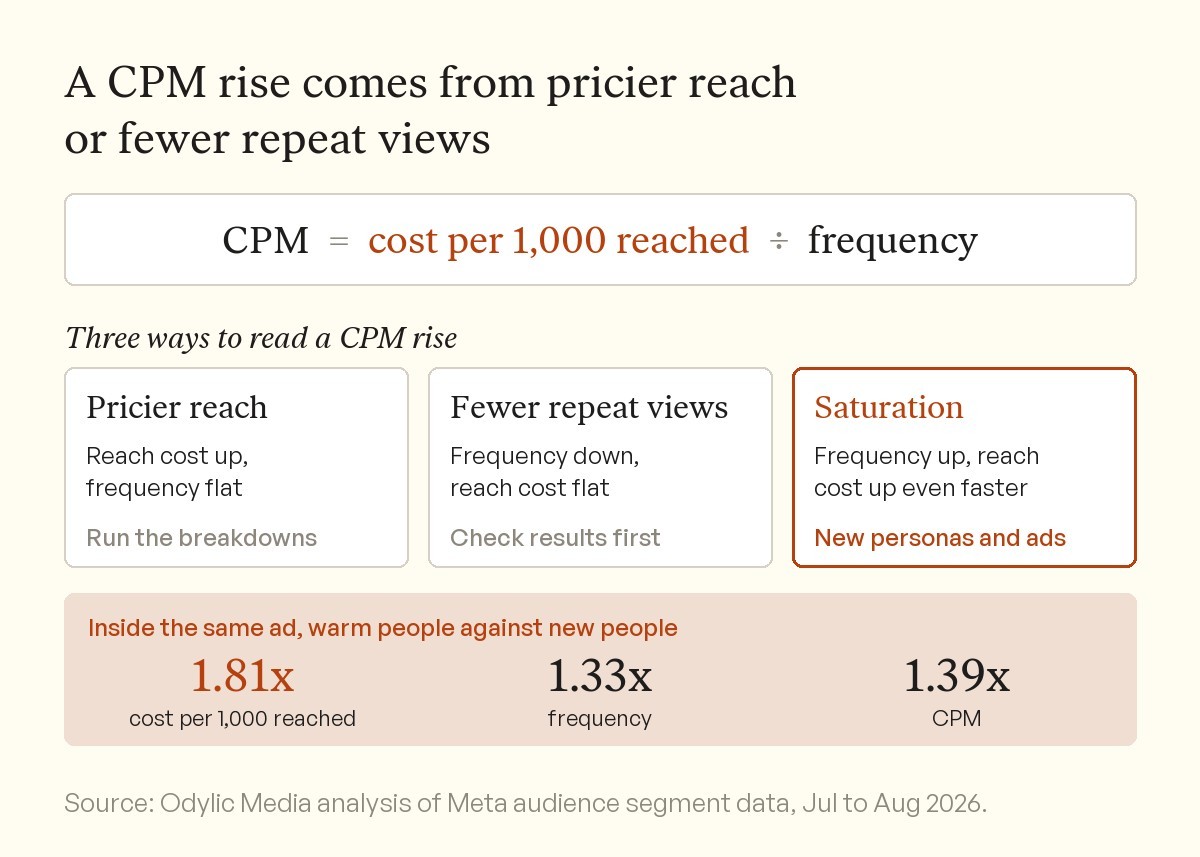
Warm reach looks 1.39 times as expensive on CPM, but each warm person costs 1.81 times as much to reach.
So CPM understates saturation. An account that leans on warm people or one persona can watch CPM creep up a little while the cost per person climbs much faster.
Before you chase either number, check whether anything in the account caused the move at all.
II. Most CPM swings come from the calendar and leave ROAS alone
The season is the biggest force. Across the brands we manage, CPMs from Thanksgiving to Cyber Monday 2025 ran a median 51% above October. Some of that came from brands' own bigger budgets. Purchases per link click ran 1.79 times the October rate over the same days, as our paper on Q4 account structure shows.
The week has its own cycle. Tuesday was the cheapest day to buy and Sunday the most expensive, a 5.1% swing that held in almost every brand. ROAS, conversion rate and cost per purchase did not move by day. On weekends people clicked about 4% more, which made up for the pricier impressions.
Consumer confidence moves CPM too, with a delay. When the Conference Board's index fell 10 points, CPM ran about 4% to 6% below its seasonal norm two to three months later. That held in most brands, but ROAS and conversion rate did not follow in any steady way.
Many buyers believe higher CPMs come with better results. We tested that inside each account. In most accounts, weeks with higher CPMs returned slightly less per dollar, though the gap was too small to trust.
Month to month, once we took out the season, CPM and ROAS moved on their own. Months with higher CPMs did lean toward higher revenue, mostly because busy seasons and bigger budgets raise both.
Meta's own guidance agrees. For ad sets optimized for conversions, Meta says CPM "may not be a good indicator of performance" (Meta). The system will buy pricier impressions when that lowers the cost per conversion.
So a high CPM is neither bad nor good on its own. In our data, pricier impressions usually came with better clicks or better closing, so ROAS held. Older audiences were the exception, as the next section shows.
The one CPM spike we expect is a brand-new ad account, which runs hot while Meta learns who should see the ads. Our paper on new ad account setup covers how to budget for it.
If the calendar does not explain the move, the breakdowns will show where it happened.
III. The breakdowns show where reach got pricier
When CPMR is up and the calendar does not explain it, run four breakdowns in Ads Manager, in this order. Meta does not let you cross age with placement for purchase results (Meta), so read each one on its own.
Start with Age and gender. Across the brands we manage, people 55 and older cost about 1.4 times as much per 1,000 impressions as people under 55. They returned about 0.84 times the ROAS.
Delivery has also aged. From the 12 months to August 2024 to the same months in 2026, the 55 and older share of spend rose a median 6.7 points. Their share of purchase value rose too, so this is not simply wasted money. It can still lift your blended CPM with no change in any single price.
Next, run Placement. From May to July 2026, Instagram Reels CPM ran about half of Instagram Feed, $14.52 against $29.13, in every brand we checked. Feed turned reach into purchases about 1.8 times as well as Reels.
ROAS did not differ across placements by enough to trust. A shift toward Feed raises CPM without hurting returns. That is why our paper on how Meta ranks ads says not to cut a placement on its own cost.
Third, run Audience segments. This breakdown splits sales campaign results into new audience, engaged audience and existing customers, as you define them in Advertising settings (Meta).
Warm people cost more to reach, and existing customers cost 2.10 times as much as new people inside the same ad. If the warm share of spend climbs, CPMR climbs with it.
Last, go ad by ad. Sort by CPMR and frequency, and look for the ads that changed. Add Meta's ad relevance diagnostics: quality ranking, engagement rate ranking and conversion rate ranking (Meta).
They show once an ad has 500 impressions. Meta says relevant ads cost less. A below-average quality ranking on a big ad is a price problem you can fix with creative.
One more check sits outside Ads Manager. If you sell supplements, food, or skin and hair care, look at your medical wording.
We have seen brands selling $25 to $30 products pay $100 CPMs after Meta treated them as medical advertisers. Meta can assign a health and wellness category to your website, and some categories limit the event data you can share (Meta). Less data leaves Meta less to optimize on.
Check your dataset in Events Manager under Settings, then Manage data source categories. If the category is wrong, request a review there (Meta).
Once you know where the price rose, the fix is rarely a targeting setting.
IV. Creative, offers and landing pages fix CPM more often than targeting
Meta's auction does not simply pick the highest bid. It picks the ad with the highest total value. That value combines the bid, Meta's estimate that the person will act and the ad's quality (Meta).
An ad people respond to can beat higher bids. So creative that earns clicks, site visits and purchases lowers the price you pay to win.
Targeting tends to work the other way. Meta buys the cheapest opportunities first and moves to pricier ones as those run out (Meta). A narrower audience runs out sooner.
So we answer each finding with an asset, not a setting.
If your buyers aged up, build creative and offers for the younger buyer you want. Do not exclude older ages. They still buy, and an exclusion shrinks the pool.
If you see the saturation pattern, open fresh pools of people with new personas, angles, formats and upper funnel creative. Too much middle and bottom funnel content pushes reach cost and frequency up together.
Each person on Meta now sees about 50% more ads than in 2020, as our paper on Meta's ad saturation gap shows. Our paper on creative diversity covers how to plan fresh pools, and net new reach shows whether they reach new people. Copies of the winner will not do it, as how Meta overfits your account explains.
If a placement looks expensive, leave it on unless it fails on your own results. Since August 2026, Meta has been removing placement exclusions from ad sets, account by account (Common Thread Collective).
Advertising settings still let you exclude Audience Network, Facebook Marketplace and the Facebook right column for the whole account (Meta). Value rules can lower your bid on a placement by up to 90%, but they cannot switch it off (Meta for Developers).
Touch targeting only to fix exclusions. If past buyers leak into prospecting, fix your existing customer definition and purchaser exclusions. Past buyers cost about twice as much to reach as new people, so a leak shows up fast in CPMR.
Sometimes nothing in the breakdowns explains a high CPM. Then we change the identity the ads run under. We run them as partnership ads with a creator in the niche, or from a new brand page built around one theme.
In our experience that fixes it about eight times in ten. That is our own count from accounts we have worked on, not a study.
On average, partnership ads did not run cheaper CPMs. They scored 108 against 100 for the brand's other ads in our partnership ads study. Treat a new identity as a fix for a stuck account, not a general way to lower CPM.
V. Diagnose the price before you change the targeting
This is the order we work in when a CPM jumps.
1. Pull CPM, CPMR and frequency side by side every week, at account and ad level. Use full-week windows, and compare with the same weeks last year when you can.
2. Name the pattern before you act: pricier reach, fewer repeat views or saturation. Saturation is frequency up with CPMR rising faster than CPM.
3. Rule out the calendar. Expect about a 5% swing from the weekday mix and about 50% above October over Black Friday week. Expect a 4% to 6% drift two to three months after a 10-point move in consumer confidence. Leave weekday budgets alone, because ROAS did not change by day.
4. Run the breakdowns in order: Age and gender, Placement, Audience segments, then ad by ad. Read each one alone.
5. If you sell supplements, food or personal care, open Manage data source categories in Events Manager. Request a review if the category is wrong, and keep condition names out of your URLs and event names.
6. Answer with assets. Make younger creative and offers if buyers aged up, add new personas for saturation, and replace big ads with a below-average quality ranking.
7. Touch targeting only to fix exclusions. Rebuild your existing customer list if the existing customer share of spend is rising.
8. If nothing explains the jump, run your best ads as partnership ads with a creator in your niche. Judge every fix on cost per new customer, not on CPM.
Most brands meet a CPM jump by tightening targeting, which shrinks the pool Meta can buy from. On Monday, put CPM, CPMR and frequency side by side for the last eight weeks and name which one moved. We still cannot say why CPM trails consumer confidence by months, because Meta does not publish how many advertisers bid.
About this research
The data comes from Meta's own reporting for DTC ad accounts we manage, 2023 to 2026, including age, placement and audience segment breakdowns. We compared each metric with the same account's own average for that month or season. The main limit is that these are patterns in what Meta delivered, not tests of what a change would cause.
See what this means for your account.
A complimentary growth session, built around your account and your numbers.

Meta Algorithm
Meta Picks Your Winner in 72 Hours, on One Purchase
At 72 hours, the ad Meta goes on to fund has a median of one purchase, and 37% have zero. More data does not make Meta's pick more profitable.

Meta Algorithm
Meta Does Not Push More Spend to Your Higher-Engagement Ads
Across the brands we manage, engagement explains 0.07% of where Meta puts spend, and a jump in likes buys no extra budget the next day. Meta funds sales.

Creative
A Few Ads Carry Every Meta Account. Your Best Ad Fades in 90 Days
The top 10% of Meta ads take 64% of a typical month's spend, and that is normal. The risk is turnover: your #1 ad fades within three months.