

Meta Algorithm

Peter Quadrel
8 min read
How Meta ranks ads in three stages. Andromeda cuts tens of millions to a few thousand, GEM-taught models score them, and an auction picks one winner.
Most media buyers talk about "the algorithm" as if it were one thing. They read a post about the Reels or Instagram Feed algorithm and build their ads around it.
The habits that follow are familiar. Brands stack interest audiences to help Meta find buyers, and they make 15 versions of a winner with new headlines.
They plan a funnel where the buyer sees a Reel, then a static, then a Story. And they put every new test inside a campaign with a tight ROAS goal.
Those habits cost money, because they do not match how Meta says its ad system works. Meta has published that system in unusual detail, and the feed algorithms most posts describe do not even rank ads.
So how does Meta choose which ad a person sees, and what can a brand still control?
Meta picks the ad in three stages, retrieval, ranking and auction, and every stage runs on models you cannot touch. You control the inputs: what is eligible, what the creative shows, how much room your bid and budget allow, and how you judge results.
Here is what Meta's own documents show. The feeds and the ad system are separate, and each surface still reads people differently. Meta now reads your creative to decide who sees it. And your bid and budget decide how much room Meta has to explore.
I. Meta's ad system runs in three stages, separate from the feeds
Meta describes its ad system as multi-stage. Each time there is a chance to show someone an ad, three stages decide which ad wins.
Retrieval comes first. Andromeda, the retrieval engine Meta described in December 2024, narrows tens of millions of eligible ads to a few thousand (Meta Engineering, Andromeda).
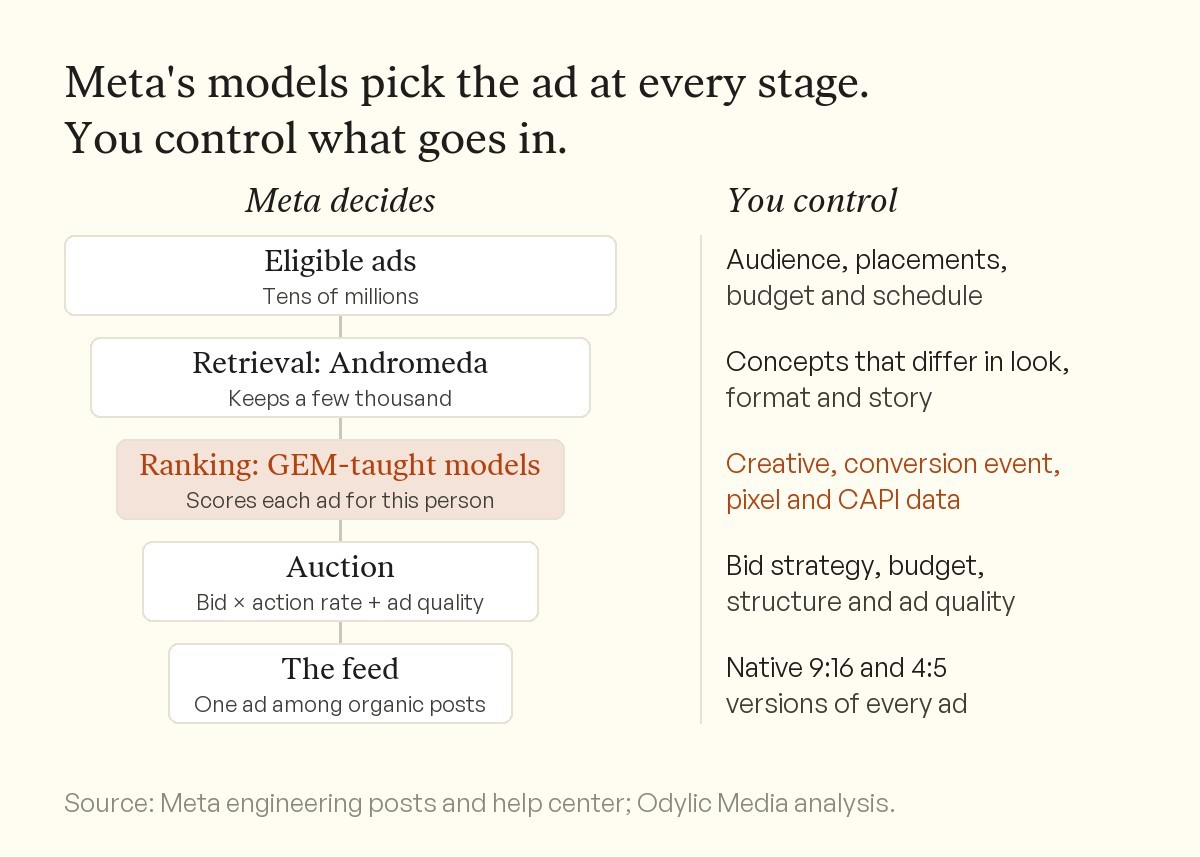
Meta's models make the choice at every stage. Your levers are the inputs each stage reads.
Ranking comes second. Larger models predict how likely this person is to take your chosen action on each remaining ad. GEM, Meta's Generative Ads Recommendation Model, is the foundation model behind this stage (Meta Engineering, GEM).
GEM does not serve ads itself. It trains offline and teaches hundreds of smaller, faster models that do the live scoring, a setup Meta's ExFM paper describes.
Lattice is Meta's project to merge many small ranking models into a few large ones that learn across surfaces and goals (Meta Lattice paper). The Adaptive Ranking Model brings a much larger model into live scoring. Meta says it lifted ad conversions 3% for the Instagram users it covered (Meta Engineering, Adaptive Ranking Model).
The auction comes last. The winning ad has the highest total value, which combines your bid, Meta's estimated action rate and ad quality (Meta, About ad auctions). The estimated action rate is the chance that this person converts from this ad.
In July 2026, Meta said it had put its first generative model into ads retrieval (Meta Q2 2026 earnings call). It calls the new approach Meta Generative Recommender.
None of these stages is a feed algorithm. Meta's system cards explain how Feed, Stories, Reels, Video and Explore rank organic posts. The Instagram Feed card says ads are "not powered by the AI we describe in this system card."
So the feed systems do not pick your ad. Why should the surface matter at all?
II. Each surface reads people differently, so build for each one
The feed systems still matter, because they shape how people behave on each surface. Instagram says Feed, Stories, Explore, Reels and Search each run their own algorithm (Instagram, ranking explained).
The signals differ a lot. The Stories card leans on closeness, such as how many messages you trade with the author. The Reels card predicts whether you will watch longer than most people or skip within three seconds.
The Explore card leans on how many people have seen and engaged with a post. Instagram Feed leans on your own activity and your history with the person posting.
So one person can live in three different apps at once. Their feed may be friends and family, while their Reels tab is full of strangers.
Meta's ad models keep those differences too. GEM learns from behavior across Facebook, Instagram and Business Messaging. It keeps its predictions "tailored to each surface's unique characteristics."
In Meta's example, Instagram video ad engagement helps predict Facebook Feed ads, while each surface keeps its own goal.
Our reading is practical. A funnel that assumes a buyer sees a Reel, then a static, then a Story is fragile. Many buyers likely spend most of their time in one surface. If your offer only exists as a static, the people who live in Reels may never see it.
Meta's placement guide points the same way. The system looks for the cheapest results across all placements, not in each one (Meta, Advantage+ placements). In Meta's own example, turning off Instagram because it looked expensive raised the average cost from $3.00 to $3.25.
So the surface sets the context. Inside it, what does the ranking model read when it scores your ad?
III. Meta now reads your creative to decide who sees it
GEM reads two kinds of input. Sequence features are a person's ordered history of ad and organic activity. Non-sequence features describe the person and the ad, including the ad format and a representation of the creative itself.
Meta replaced hand-built summaries with timelines that keep the order, timing and context of each event (Meta Engineering, sequence learning). GEM can now read up to thousands of events per person.
A design called InterFormer lets that history and the ad's features inform each other at every layer. Another Meta design, Wukong, learns which combinations of features matter.
So Meta scores each ad for each person at each moment. Two people in the same interest audience can get very different scores for the same ad. Meta's help center recommends broad audiences, which give the system more room to find cheaper conversions (Meta, About ad delivery).
The creative now carries more weight in that match. Meta says Generative Recommender uses large language models to "reason about ad content and user preferences together."
Meta's engineers also wrote in August 2026 that content features help most for new ads with little history (Meta Engineering, multi-stage ranking). A 2025 Meta paper, used in live ads ranking, groups ads by their content. Similar ads then share what the model learns (Zheng et al.).
That helps explain how Meta can pick a winner on one purchase, as our study of the 72-hour pick found.
Our reading goes one step further. If 15 versions share one image and change only the headline, the model likely sees one ad, not fifteen. Five concepts that differ in look, format and story give it five different inputs.
Meta has not published how much weight the creative gets, so treat this as our interpretation. Our paper on how Meta overfits your account shows that copies of the winner keep finding the same buyer.
The same timelines explain the journey point. Meta says its larger ranking models can represent the steps of a purchase journey across surfaces and campaigns (Meta for Business). Its example is a person who books a ski resort room and then sees ads for ski gear, not more resorts.
Meta has not published that it plans the order of your ads. Our reading is narrower. Your ad reaches a person who already carries a history, often including your other ads. So its own last-click ROAS shows only a piece of its job.
That is why we judge new creative on account-level new-customer results. Our study of engagement and spend found that Meta funds the ads that sell, not the ads that collect likes.
If Meta does the matching, what is left for you to steer?
IV. Your bid and budget decide how far Meta can explore
Your bid is the one auction input you set directly.
Meta groups its bid strategies three ways (Meta, About bid strategies). Highest volume and highest value aim to spend the full budget. Cost per result goal and ROAS goal aim to hold an average cost or return. Bid cap sets a ceiling on every auction.
Meta states the trade-off plainly. When the market gets competitive, goal-based bidding "prioritizes respecting your target over additional scale."
Budget structure works the same way. Advantage+ campaign budget, which most buyers still call CBO, may put most of the budget into one ad set (Meta, Advantage+ campaign budget). Inside an ad set, Meta shows the ad it predicts will get the lowest cost per result.
So structure decides what is allowed to compete. Five campaigns with one ad set each force Meta to spend on all five. One campaign with five ad sets lets Meta ignore four of them.
We see the same mistake in audit after audit. A brand puts its winning format, such as founder videos, in a CBO campaign with a ROAS goal and a tight budget. Then it adds new statics as another ad set in that campaign and wonders why they never spend.
Every setting in that campaign tells Meta to play it safe. The new ads have no history, the budget leaves no room, and the ROAS goal punishes risk.
Meta describes the learning phase as the time when the system is still exploring how to deliver (Meta, About the learning phase). We treat the whole account as a mix of exploring and exploiting.
Tight goals, low budgets and CBO exploit proven, bottom-funnel assets. Highest volume, looser budgets and ad set budgets (ABO) let Meta explore new formats, personas and offers.
The right mix depends on the journey. A low-AOV impulse product that sells in one or two touches can test inside tight structures. A $3,000 product that needs research will starve its top of funnel there, because Meta keeps feeding the retargeting ad with quick ROAS.
Most accounts we audit lean too far one way. They either dry out the funnel every month or never scale a winner. So where should your hours go?
V. Spend your time on the inputs Meta cannot make for you
1. Keep Advantage+ placements on, and give every ad a 9:16 and a 4:5 version. Do not cut a placement because its own cost per result looks high.
2. Pull the placement breakdown for each persona every month, and match production to it. If 60% of a persona's purchases come from Reels, make about 60% of that persona's creative vertical video.
3. Give every format its own top, middle and bottom of funnel, such as offer Reels and problem-led statics. Never crop one format from another.
4. Tag every ad by persona, format and funnel stage, then fill the empty cells in that grid. Stop making versions past the third of a concept.
5. Launch a new angle or persona as a full-funnel set of 10 to 20 creatives across formats. Judge the set on account-level new-customer ROAS and CPA, not ad by ad.
6. Keep tests out of your efficiency campaigns. Test on highest volume with ad set budgets, one new concept per ad set. Scale proven assets in a campaign budget with a cost per result goal or ROAS goal.
7. Set the mix by journey length. Long, high-AOV journeys need looser budgets and more ad set budgets. Our paper on attribution settings covers which window fits them.
8. Watch account new-customer ROAS for a week after you pause a high-spend ad with weak ROAS. Turn the ad back on if it drops.
The habits in our opening assume one algorithm and a media buyer who can out-target it. Meta describes separate feeds, three stages and models that read your creative.
On Monday, open the placement breakdown for your biggest persona and list the formats its funnel is missing. We still do not know how much weight Meta gives the creative against a person's history, because Meta publishes the design, not the weights.
About this research
This paper draws on Meta's engineering posts, research papers, help center pages, system cards and earnings calls, read in October 2026. It also draws on our experience running Meta accounts for DTC brands, and we label where we go beyond Meta's documents. Meta publishes how the system is built, not how it weighs any one account, so our actions are not a controlled test.
See what this means for your account.
A complimentary growth session, built around your account and your numbers.

Meta Algorithm
Meta Picks Your Winner in 72 Hours, on One Purchase
At 72 hours, the ad Meta goes on to fund has a median of one purchase, and 37% have zero. More data does not make Meta's pick more profitable.

Meta Algorithm
Meta Does Not Push More Spend to Your Higher-Engagement Ads
Across the brands we manage, engagement explains 0.07% of where Meta puts spend, and a jump in likes buys no extra budget the next day. Meta funds sales.

Creative
A Few Ads Carry Every Meta Account. Your Best Ad Fades in 90 Days
The top 10% of Meta ads take 64% of a typical month's spend, and that is normal. The risk is turnover: your #1 ad fades within three months.