

Account Structure

Peter Quadrel
11 min read
Our 2026 new Meta ad account setup: a verified Pixel and Conversions API, one sales campaign on highest volume, and a daily budget of about 7x target CPA.
Most brands launch a new Meta ad account by building everything at once. They add extra tracking pixels and custom events, retarget from day one and run five campaigns with seven ad sets each.
That build costs money twice. A new account has no purchase history, so Meta pays high prices while it learns who should see the ads. And when results disappoint, nobody can tell whether the pixel, the tool, the attribution setting or the product broke.
So what does a new account actually need in its first weeks?
It needs less than most brands build. A new account needs clean standard events and one sales campaign on highest volume. It also needs loose attribution, a budget that can feed one ad set, creative with real range and the patience to leave it alone.
Here is what we found. Tracking fails quietly, so verify it before launch. Meta decides on very little data, so give it one place to learn.
That learning has a price, so budget for it. Creative is the main input Meta can read, so give it range. And the first weeks are for reading Meta's choices, not rebuilding.
The plan fits on one timeline. Verify tracking before day 0, read Meta's pick at 72 hours and recheck it on days 7 and 14. Tighten attribution at 30 to 90 days, and split the structure only after several steady weeks near 50 conversions a week.
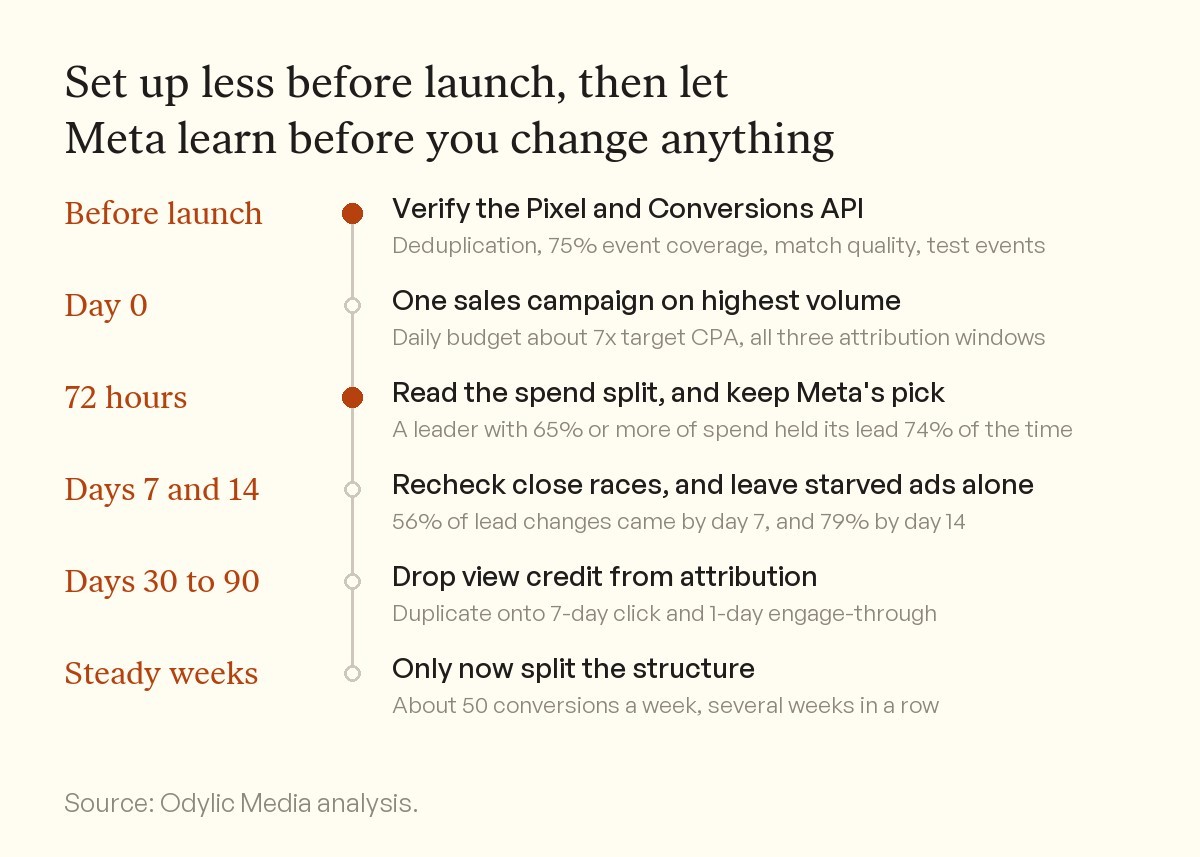
Most of a new account's setup happens before launch. After that, the job is to read Meta's choices and leave the structure alone.
I. Tracking fails quietly, so verify it before you launch
A new account's tracking should be painfully simple. Run the Meta Pixel and the Conversions API together, and send Meta's standard events: view content, add to cart, initiate checkout and purchase.
Skip custom events, extra tracking pixels, attribution tools and new customer tracking at launch. Each one adds a system you will second-guess when results swing.
Simple does not mean unchecked. In our tracking audits, every pixel in use had fired within the last day. The failures were quieter than a dead pixel.
One account had Advanced Matching off on its only live pixel. In some stores, purchases outnumbered checkouts, because the checkout event missed the express checkout path. A booking tool at a service business logged appointments as purchases, so Meta optimized for sales that never happened.
None of these shows up as an error in Ads Manager. The campaigns keep spending, and Meta learns from the wrong data.
So before the first ad, we check four things in Events Manager. When the Pixel and the Conversions API both send a purchase, the two copies share one event ID, so Meta counts it once. The Conversions API covers at least 75% of the events the Pixel sends, which is Meta's own target (Meta, Conversions API best practices).
Every event carries email, phone number and zip code, which Meta grades as Event Match Quality, out of 10 (Meta for Developers). And a real test order shows each funnel step arriving in the Test events tool.
Health-adjacent brands should also look for a data restriction in the dataset's settings. Meta can switch on Core Setup for sites in sensitive fields such as health, and it limits custom parameters and URL paths (Jon Loomer).
Then add UTM parameters to every ad and leave the tracking alone. So how should a new account use its data while there is so little of it?
II. Meta decides on little data, so give it one place to learn
Meta does not wait for 50 conversions to make its choices. In our study of early signals, about 90% of creative launches were decided while the ad set ran under 50 conversions a week. The median ad set had 7.
In our study of how Meta picks a winner in 72 hours, the funded ad had a median of one purchase when Meta picked it. 37% had none.
So we do not spread that little data thin. We launch one Advantage+ sales campaign, the successor to Advantage+ shopping campaigns, with one broad ad set full of diverse ads (Meta for Developers). The budget runs on Advantage+ campaign budget, Meta's current name for CBO.
This helps the ad set, not the creative pick. Meta's pick beat the runner-up on ROAS 47% of the time under 10 conversions a week, and 47% at 50 or more. Volume steadies delivery, which is why Meta's first fix for Learning limited is to combine ad sets (Meta, About learning limited).
Bid on highest volume, the strategy Meta used to call lowest cost. Meta reserves bid cap for advertisers who know their predicted conversion rates. It recommends 50 to 100 or more conversions a week for a cost per result goal or a ROAS goal (Meta, About bid strategies). A new account has neither, so watch CPM, the cost to reach 1,000 people and frequency instead.
Keep the audience broad. Set location, minimum age and language as audience controls, which Meta treats as hard limits. Add 1 to 5 audience suggestions, such as an age range or a lookalike of past buyers (Meta, Advantage+ audience). Meta can go past them, but on a new account they save it some guesswork.
If the brand has sold before, add the customer list in Advertising settings and exclude past buyers. Meta only reports audience segments from the day you define them, as our paper on net new reach explains.
Leave Advantage+ placements on, but block Audience Network at the account level. In Advertising settings, turn on "My business can only advertise on specific placements" and uncheck Audience Network (Meta). Uncheck Facebook Marketplace too, unless you sell a cheaper impulse product.
The change can take up to 48 hours to apply. Since August 2026, Meta has been removing placement exclusions from ad sets, so this is the setting that lasts (Jon Loomer).
Turn off Test new creative features and most Advantage+ creative enhancements too, as our Q4 account structure paper explains. Launch one product and a few variations, or a tight handful of SKUs, not the whole catalog. Send all traffic to one page, a collection page for several SKUs or a product page for one.
One campaign only works if the budget can feed it. So how much does a new account need?
III. The learning has a price, so budget it before launch
Meta's learning phase usually ends after about 50 results in the week after the ad set's last significant edit (Meta, About the learning phase). Nothing magic happens at 50 instead of 45. Treat it as a target for stable delivery, not a pass mark for creative.
Fifty a week is about 7 a day. So our starting rule is a daily budget of about 7 times your target CPA. An $80 CPA needs about $560 a day, and a $40 CPA needs about $280. If you do not know your CPA, estimate it from category benchmarks and brands in your space.
If the budget cannot get near 50, the ad set will likely sit in Learning limited. Meta's suggested fix is to optimize for an event that happens more often, such as add to cart instead of purchase.
We take that step only at an AOV of about $800 and up. At $500 or below, push through on purchases, raise the budget or fix the offer first.
Pick the deepest event that still clears 50 a week. In most stores the order runs purchase, initiate checkout, add to cart, then view content. Run it in its own campaign next to the purchase campaign, and move back toward purchase as volume builds.
Move no further up the funnel than you must. In our study of early signals, the deeper the event, the more closely it tracked where Meta sent purchase budget. Content views tracked nothing we could detect.
Then budget for the learning itself. Every new account pays what we call an admission ticket, and what our attribution paper calls the CPM tax. With no history on your pixel, page or ads, CPMs run high and conversion rates run low at first.
For a brand with a $50 to $80 AOV, we expect the first $10,000 of spend to feel overpriced. Health-adjacent brands often pay $15,000 to $20,000 before costs settle, and active ingredients or medical claims push costs higher. Put that money in the plan before you launch.
If results stay poor, compare your CPM, cost to reach 1,000 people and frequency with brands in your niche. If yours run far higher, you are still paying the ticket. If they are in line and sales still do not come, the problem is the product or the offer. Our paper on high CPMs shows how to tell which number moved.
A budget buys Meta time to learn. Creative decides what it learns from.
IV. Creative is the input Meta reads most, so give it range
On a new account, Meta has little to go on except your creative. For new ads with no history, Meta's models lean on the content itself, as our 72-hour paper explains. Ten versions of one ad give it one thing to learn, as our paper on creative diversity explains.
Our starting mix is about 50% Reels and other short video, 30% static images and 20% carousels. In our experience, Reels is where new people find a brand fastest, and carousels are the format most brands skip.
Fashion brands can weight statics higher, and problem-solution brands should lean harder into video. Keep about 70% of the mix native-looking rather than produced.
Run partnership ads from day one. In our experience, nothing helps a new account reach 50 events a week sooner. Give up to about 25% of the ads to 3 to 5 creators, each standing for a different persona.
Our partnership ads study found these ads were not cheaper per sale, but they stayed live 1.89x as long. Give each creator their own ad set in the launch campaign, with a minimum daily spend of 3 times target CPA, divided by 7. At an $80 CPA, that is about $34 a day.
Without that floor, Meta picks one creator and starves the rest. Meta does not promise to hit ad set minimums, so check delivery after a few days.
Cap the number of ads at what the budget can show. Our rule of thumb is about 1,000 impressions per ad per day, so divide the daily budget by the CPM. At $500 a day and a $30 CPM, that is about 16 creatives. At $200 a day and a $40 CPM, it is about 5.
Test the variable that sells: the product for an aesthetic brand, and the sales argument for a utility brand. Our paper on premium fashion SKU testing covers the split.
Start with 1 to 3 personas and 1 to 3 angles. Name every ad by product, persona, emotion, angle, concept, format and production style. Launch them as one mixed batch rather than one variable a week, and let the names show the patterns.
Hold back three things. Run no retargeting until the audience pools are large. Run no Advantage+ catalog ads unless you are an aesthetic brand with well-designed catalog creative.
And keep one concept per ad. One ad can hold up to 10 images and videos, and Meta picks what to show (Meta, Flexible ad format). In discovery, that pooling hides which concept Meta chose.
Then the account goes live, and the hardest job begins.
V. In the first weeks, read Meta's choices and leave the structure alone
Meta makes its first call fast. In our 72-hour study, a leader with 65% or more of the early spend kept the lead through day 13 in 74% of launches. A leader with under 35% kept it in only 34%.
Read the spend split at 72 hours, and keep Meta's pick even when the runner-up shows better early ROAS. That early edge predicted nothing about later ROAS.
Look again on days 7 and 14. 56% of lead changes came by day 7, and 79% by day 14.
Cut very little. Pausing the ads Meta starves changes almost nothing, as our paper on almost never turning off an ad shows. Turn an ad off when it takes a big share of spend for 7 to 14 days and account results fall as it grows. A broken page or a sold-out product is also a good reason.
Keep attribution on 7-day click, 1-day engage-through and 1-day view. Hold it for 30 days at high daily spend, and up to 90 days at low spend.
Since March 2026, only a link click counts as a click. Likes, comments, saves, shares and 5-second video views count as engage-through instead (Jon Loomer). Compare attribution settings in Ads Manager shows what each window adds.
When the time comes, duplicate the campaign onto 7-day click and 1-day engage-through. Do not edit the live one.
When the first ad set fills, launch the next batch as its own ad set. Adding ads to a live ad set sends it back into learning (Meta, Significant edits).
Change the structure only when the account is steady. That means about 50 conversions a week for several weeks in a row, with steady CPM, AOV, conversion rate and ROAS. Store revenue should agree with Meta. One good week is not enough.
Then move to the year-round build in our Q4 paper. It has campaigns by category or region, weekly ad sets and a reactivation campaign for past buyers.
VI. Set up less, verify more and wait for steady weeks
1. Run the Meta Pixel and the Conversions API with standard events only. Check deduplication, 75% event coverage, match quality and a real test order before launch.
2. Block Audience Network at the account level at least 48 hours before launch, and add your customer list in Advertising settings.
3. Launch one Advantage+ sales campaign on highest volume, with one broad ad set and one ad set per creator. Use no bid cap.
4. Set the daily budget at about 7 times target CPA. At an AOV of $800 or more, step back to the deepest event that clears 50 a week.
5. Set location, minimum age and language as controls, add 1 to 5 audience suggestions and exclude past buyers.
6. Launch about 50% short video, 30% static and 20% carousel, with about a quarter from creators. Run no more ads than the daily budget divided by the CPM.
7. Run 7-day click, 1-day engage-through and 1-day view for 30 to 90 days, then duplicate onto 7-day click and 1-day engage-through.
8. Read the spend split at 72 hours, recheck on days 7 and 14, and leave the ads Meta starves alone.
9. Budget the first $10,000 of spend as the admission ticket at a $50 to $80 AOV. Change the structure only after several steady weeks near 50 conversions a week.
Most brands launch a new account with everything they might need someday. We launch with what Meta needs now: clean events, one place to learn, a budget that can feed it and creative with range.
On Monday, open Events Manager and check deduplication, event coverage and match quality before the first ad goes live. We still do not know how much faster CPMs fall on this setup, because we have never launched one account two ways.
About this research
This paper draws on the new and rebuilt Meta accounts we have launched and audited. It also uses our 2025 to 2026 studies of early signals and of Meta's 72-hour pick, plus our September 2026 tracking audit. The budget rule, creative mix, creative cap and admission ticket ranges are rules of thumb from our account work, not a controlled test.
See what this means for your account.
A complimentary growth session, built around your account and your numbers.

Meta Algorithm
Meta Picks Your Winner in 72 Hours, on One Purchase
At 72 hours, the ad Meta goes on to fund has a median of one purchase, and 37% have zero. More data does not make Meta's pick more profitable.

Meta Algorithm
Meta Does Not Push More Spend to Your Higher-Engagement Ads
Across the brands we manage, engagement explains 0.07% of where Meta puts spend, and a jump in likes buys no extra budget the next day. Meta funds sales.

Creative
A Few Ads Carry Every Meta Account. Your Best Ad Fades in 90 Days
The top 10% of Meta ads take 64% of a typical month's spend, and that is normal. The risk is turnover: your #1 ad fades within three months.