

Meta Algorithm

Peter Quadrel
8 min read
Meta picks each ad from a buyer's history. Ads that start the journey show 1.62 ROAS vs 3.07 on past buyers, so almost never turn off a Meta ad.
Most brands review their Meta ads the same way. They sort the ads by ROAS, find the ones at the bottom and turn them off.
That habit made sense when Meta judged each ad on its own. Now it costs money. Meta picks the next ad for each person from that person's history, so one ad's ROAS tells you little about why anyone bought. The low-ROAS ad you pause may be the ad that started a sale another ad got credit for.
The habit also seems to fit what we have published before. Your best ad fades within about three months, and a few ads carry the whole account. If ads fade anyway, why not cut the weak ones early?
So should you turn off ads that look weak, and how does that fit with ads that fade?
Almost never turn off an ad that Meta is still funding. Meta already retires ads on its own, and your job is to fill the gaps in the buyer's journey.
Here is what we found. The ads that start journeys report the lowest ROAS, and Meta picks each ad from the buyer's history. Meta also retires ads by itself, and the missing journey steps cost more than the weak ads.
I. The ads that start journeys report the lowest ROAS
Start with who the big ads reach. In our study of Meta's audience segment reporting, the top 10% of ads by spend sent 86.4% of their spend to new people. The bottom half of ads sent 78.3%. That held in most accounts.
So the ads Meta funds hardest are mostly first touches, shown to people who have never engaged with the brand.
Meta's own ROAS rises as the audience gets warmer. In the typical account, the biggest ads showed 1.62 ROAS on new people. They showed 2.22 on people who had engaged but never bought, and 3.07 on past buyers.
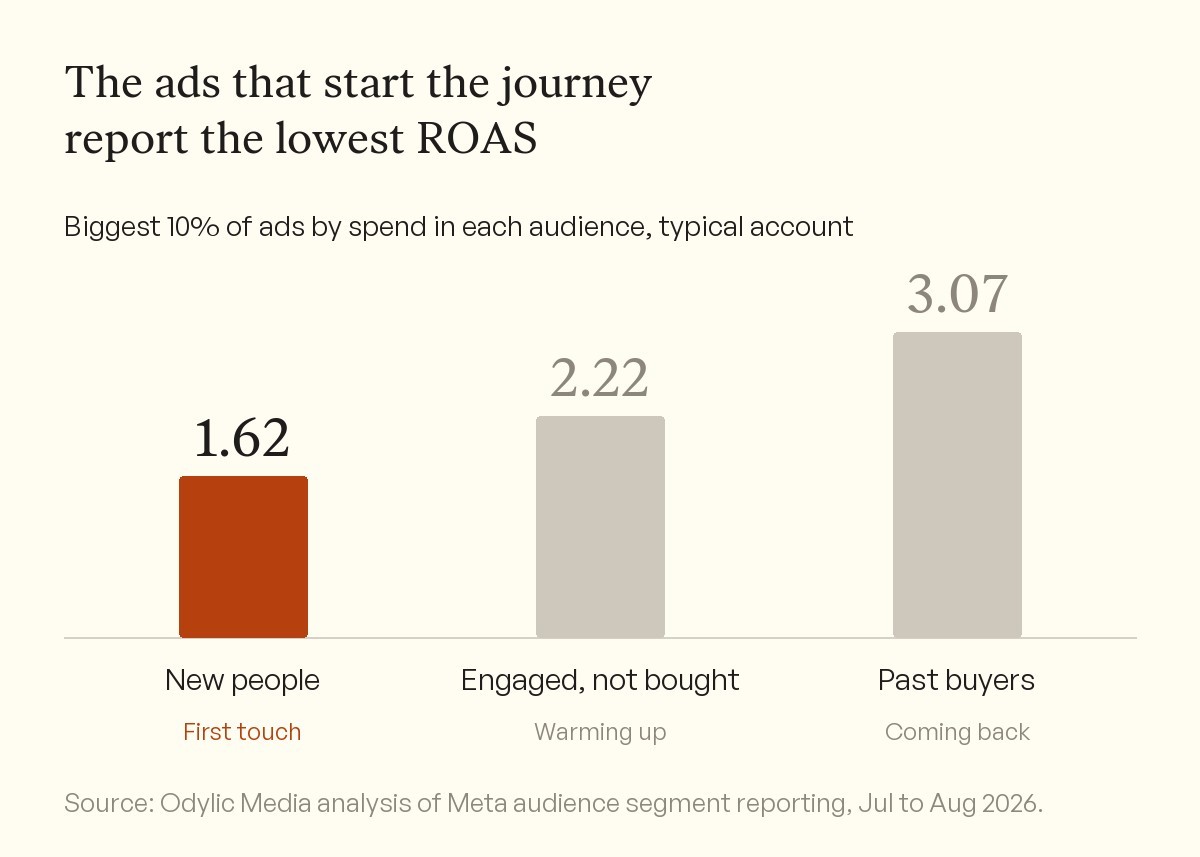
Meta's own numbers make the ads that reach new people look weakest, though that is where journeys start.
That gap does not mean warm ads are better ads. A person who already knows the brand is closer to buying, and some earlier touch brought them there. Meta's ROAS shows where the credit landed, not which touch did the work.
Big ads are usually still the best ads overall. In our study of how few ads carry a Meta account, the top 10% by spend ran 1.71 ROAS and everything else ran 1.12. On new people, the ads outside the top 10% averaged 0.93, below break-even.
So a high-spend ad with weak ROAS is unusual. When you find one, the first question is who it reaches, not whether to pause it.
The ads Meta funds are your journey in practice. It takes only about 22% of the ads to reach 80% of a month's spend. Those ads are the path most buyers walk, whatever their own ROAS says.
So why would Meta keep funding an ad whose ROAS looks weak?
II. Meta picks each ad from the buyer's history
Meta chooses ads one person at a time. When you run several ads, its help center says, Meta shows each person the ad most likely to get the lowest cost per result. It bases that on predictions of future performance, not on each ad's past results (Meta, About ad delivery).
Those predictions now draw on each person's history. In 2024, Meta's engineers described Sequence Learning. It feeds Meta's models each person's events in time order, such as the recent ads they engaged with (Meta Engineering, 2024).
In March 2025, Meta told advertisers what this is for. Sequence Learning looks at the actions a person takes before and after seeing an ad. Meta uses those patterns to work out which sequence of ads leads to a purchase. It credited the change with 3% more conversions in the segments it tested (Meta, AI innovation in ads ranking).
The timelines keep getting longer. In August 2026, Meta's engineers wrote that their models read thousands of a person's clicks, views and purchases. Results improve as those sequences grow (Meta Engineering, 2026).
Meta does not document everything the journey idea implies. It publishes no journey score for your ads, and Ads Manager does not show which ads a buyer saw before the one that got credit. The journey view is our reading of what Meta publishes, plus what we see in accounts.
Our working estimate is that a premium buyer sees 50 to 100 of a brand's ads before buying. That comes from the accounts we run, not from a measured count. Even at a fraction of that, one ad's ROAS cannot tell you why the sale happened.
You can still set the order yourself. Meta's ad sequencing tool works in auction and reservation campaigns. It needs an ad set budget, a lifetime budget and a target frequency, which suits a planned launch story (Meta, Sequence ads). In an always-on sales campaign, Meta picks the order.
If Meta is building these paths, why do ads still fade so fast?
III. Meta retires ads on its own, so pausing rarely helps
Ads do fade. In our concentration study, the #1 ad held 16% of spend in its peak month. It held 7% the next month and about 2% the month after. By the third month, it held nothing.
Nobody had to pause it. Meta moved the money to a newer ad, and a new #1 took over about every seven weeks.
Meta also retires the weak ads for you. In a typical month, 55% of active ads recorded zero purchases, and they held only 8.5% of spend. Meta had starved them long before anyone went looking. Pausing them by hand moves almost no money.
Our fatigue study points the same way. The typical ad in our accounts lived about 39 to 45 days. Fatigue, meaning rising costs and falling clicks, was the likely cause in under 10% of deaths.
About 21% of the ads that died still had steady or rising ROAS when their spend stopped. A team paused some of them, and other ads took the budget from the rest. Only about 15% showed a clear drop in ROAS first.
That split is our least certain finding. Most deaths, 57%, could not be judged at all, because the ad had too little spend or too few sales near the end.
Meta's own fatigue tool leans the same way. On ad sets with a single creative, Ads Manager flags Creative fatigue when cost per result reaches twice that of your past ads. Even then, Meta recommends adding a new, clearly different ad. It notes that keeping the original running may get you more results (Meta, Creative fatigue recommendations).
Swapping ads has a cost too. Pausing one ad is not a significant edit by Meta's rules. Adding its replacement is, and that sends the ad set back into learning (Meta, Significant edits).
Meta also says its predictions for an ad get more accurate each time the ad is shown. A replacement starts that learning from zero.
So "almost never turn off an ad" and "your best ad fades within 90 days" are the same advice. Let Meta move the money, and have the next ad live before the old one fades. Our paper on how Meta picks a winning ad in 72 hours explains why the next ad needs to be ready early.
If pausing is rarely the answer, where should the time go?
IV. Missing journey steps cost more than weak ads
The bigger risk is not a weak ad. It is a step in the journey with no ad at all, a message every buyer needs that nobody in the account is seeing.
Start by placing each ad in the journey. Meta's audience segments breakdown splits spend into new audience, engaged audience and existing customers, as you define them (Meta, Audience segments reporting). Add frequency and cost per 1,000 Meta Accounts reached, the metric Meta used to call cost per 1,000 Accounts Center accounts reached.
Those numbers do separate cold from warm. Inside the same ad, reaching a warm person cost about 1.8 times as much as reaching a new one. Warm people also saw it 1.3 times as often, and both held in every account we tested.
When segment data is missing, frequency alone picked the warmer half of ads 73% of the time. CPM alone did no better than a coin flip.
Placed this way, most accounts look lopsided. The typical ad got 96% of its spend from one audience. By delivery, 78% of ads in the typical account were top of funnel and 1% were middle of funnel. That does not prove the middle messages are missing, but it is where we look first.
Then find the holes. Pull support tickets, comments and reviews, and list the questions that keep coming back. Warranty worries, sizing questions and comparisons with competitors are the usual ones.
If it shows up in support, it needs an ad. Redo this list every month.
Each journey needs four kinds of ads. A first stop earns attention, often with content that looks native to the feed, and a product breakdown builds understanding. Mechanism and benefit ads build desire, and proof and risk reversal answer the objection that stops the sale.
Each persona also needs its own journey. Technical buyers need specs, social buyers need proof and value buyers need guarantees. Our paper on how Meta overfits your account to one buyer shows what happens when an account only knows one persona.
Fill the holes with a few distinct ads, not dozens of variants. Meta warns that when you run too many ads, each one delivers less often and fewer exit learning (Meta, About managing ad volume). In our volume study, over 40% of launches in high-volume months never got $50 of spend in their first 30 days.
So what should change in your weekly review?
V. Audit the journey before you turn off an ad
1. Pull the audience segment split before you pause any ad Meta is funding. If most of its spend reaches new people, treat it as a first touch. Judge it on account-level new-customer results, not on its own ROAS.
2. Leave the starved ads alone. Zero-sale ads are about 55% of active ads and 8.5% of spend. Pausing them tidies the account and changes almost nothing.
3. Turn an ad off only for a short list of reasons. The offer expired, the product is out of stock, the landing page broke, or the ad carries a policy or brand risk. Also turn it off if account-level new-customer revenue falls as the ad gains spend.
4. Launch the replacement before you touch the old ad. If Ads Manager shows Creative fatigue, add a clearly different ad and let Meta shift the spend. Plan for a new #1 about every seven weeks.
5. Map the journey for each persona. Break your customer file into 3 to 8 personas, and list what each must believe before buying. Check that all four kinds of ads are live for each persona.
6. Run the random-order test. Imagine a buyer saw every live ad in random order. Ask whether they would get a full story that answers every objection, or a pile of unrelated hooks.
7. Judge the journey at the account level. Track new-customer ROAS or new-customer MER as the main number. For long, high-AOV journeys, read our paper on Meta attribution settings before you switch to incremental attribution.
The brands that sort by ROAS and pause the bottom are judging a team one player at a time. On Monday, before you turn off any ad, open the audience segments breakdown and see who it reaches.
Because Meta does not show which ads a buyer saw first, we cannot yet prove how much a paused first touch costs your retargeting. A holdout test on one big first-touch ad would tell you for your own account.
About this research
This paper draws on the Meta ad accounts we manage and audit. The audience findings use Meta's own audience segment reporting from July and August 2026. The lifespan and cause-of-death findings use a year of ad-level data, mostly from lower-priced consumer brands. We see what Meta did with each ad, not what a pause would have caused.
See what this means for your account.
A complimentary growth session, built around your account and your numbers.

Meta Algorithm
Meta Picks Your Winner in 72 Hours, on One Purchase
At 72 hours, the ad Meta goes on to fund has a median of one purchase, and 37% have zero. More data does not make Meta's pick more profitable.

Meta Algorithm
Meta Does Not Push More Spend to Your Higher-Engagement Ads
Across the brands we manage, engagement explains 0.07% of where Meta puts spend, and a jump in likes buys no extra budget the next day. Meta funds sales.

Creative
A Few Ads Carry Every Meta Account. Your Best Ad Fades in 90 Days
The top 10% of Meta ads take 64% of a typical month's spend, and that is normal. The risk is turnover: your #1 ad fades within three months.