

Account Structure

By
Peter Quadrel
7 min read
Partnership ads on Meta stayed live 1.89x as long as other ads, at about the same cost per sale. Here is the campaign structure we use, setting by setting.
Most brands now pay creators for content. They run that content as partnership ads, the ads that show the creator's handle and a "Paid partnership" label. Then they put those ads in the main campaign next to everything else.
Meta picks one or two creators in the first few days and spends almost nothing on the rest. That costs you money in two ways.
You paid every creator before the first impression, so each creator Meta skips is content you bought and never tested. The creators Meta does fund often get cut in week one, because their early CPA looks high.
So we asked what partnership ads actually do better than other ads, and how you should set them up to get it. We looked at partnership ads across the brands we manage over two years. We compared each one with the other ads the same brand ran in the same months.
Partnership ads were not cheaper per sale, but they stayed live almost twice as long, and the right campaign structure protects that.
Here is what we found. Partnership ads last almost twice as long. They cost about the same per sale. The campaign setup decides who they reach. And a spend floor on each creator matters more than any other setting.
I. Partnership ads stay live almost twice as long
A partnership ad runs under a creator's identity, with the "Paid partnership" label on it. Operators also call them creator ads, whitelisting or dark posts.
Most brands we checked run them. Over the last 12 months, the typical brand that runs them put 11% of its spend into them. The heaviest user put 45%.
We compared partnership ads with other ads the same brand launched in the same months. Partnership ads stayed live more days in every brand where we had enough of both to compare.
The typical partnership ad stayed live 1.89x as long as the brand's other ads. It was 1.72x as likely to still be spending at day 60. At day 90, it was 2.04x as likely.
The budget pattern shows the gap most clearly. A typical static ad spent 99% of its lifetime budget by day 14. A typical partnership ad had spent 53% by day 14, and it was still spending after week four.
The obvious objection is that buyers simply fund partnership ads harder. They do. In the typical brand, a partnership ad got 2.07x the first-week budget of other ads.
So we matched each partnership ad with other ads that had similar first-week spend. The gap got bigger, not smaller.
Before matching, partnership ads stayed live 1.46x as many of their first 90 days. After matching, that rose to 1.63x. Partnership ads came out ahead in every brand we tested.
A longer life only helps if each dollar still works. So do partnership ads also cost less per sale?
II. Partnership ads cost about the same per sale
The common pitch says partnership ads are the best format on Meta. The story goes that they get the most engagement, the lowest CPMs and the highest ROAS. Our data does not back that up.
We set each brand's other ads at 100 and scored partnership ads against them. Partnership ads came in at 110 on ROAS. They scored 102 on cost per purchase. They scored 108 on CPM, so their CPMs ran slightly higher, not lower.
All three gaps were too small to trust. Per dollar, the result is close to a tie.
Partnership ads did bring in more revenue per ad, at 237 on the same scale. Buyers and Meta gave each one about twice the money. Each dollar did not work harder.
They also sell in a different way. Partnership ads scored 121 on clicks. They scored 92 on sales per click.
So you should judge partnership ads as a format that lasts, not one that sells for less. If the format does not make each dollar cheaper, why do some brands turn it into their best cold-traffic ad?
III. The campaign setup decides who partnership ads reach
One brand shows what the format can do on cold traffic with the right setup. In a tech accessories brand, partnership ads went from 0% to over 50% of monthly spend within a year.
On prospecting traffic in that brand, partnership ads posted 1.34 ROAS. Static ads posted 1.13, and other video posted 0.96.
Cold partnership ads had a 2.91% click-through rate. Static ads had 1.60%. We only compared ads from the same period, because the brand changed its attribution setting in January 2026.
That cold-traffic edge did not repeat across the brands we manage. Over two recent months, partnership ads scored 99 on cold ROAS. They scored 122 on cold CPM.
Meta also did not deliver them to a colder audience than other ads. Their prospecting share of spend scored 104.
So the format alone does not find new people. In the tech accessories brand, every partnership ad ran in a prospecting campaign. The setup made them a cold-traffic tool.
Every setting in our structure does one of two jobs. It gives each creator a fair, long test, or it keeps the budget on people who have not bought.
One CBO campaign, one ad set per creator, purchaser exclusions and broad targeting handle most of that. So which setting protects the test the most?
IV. The spend floor matters more than any other setting
You paid the creator before the first impression, so that money is already spent. Without a floor, CBO can pick one creator in the first days and starve the rest.
This is the same problem we describe in our paper on how Meta overfits to what an account already does.
We set a minimum daily spend on each creator's ad set at 3x your account CPA, spread over 7 days.
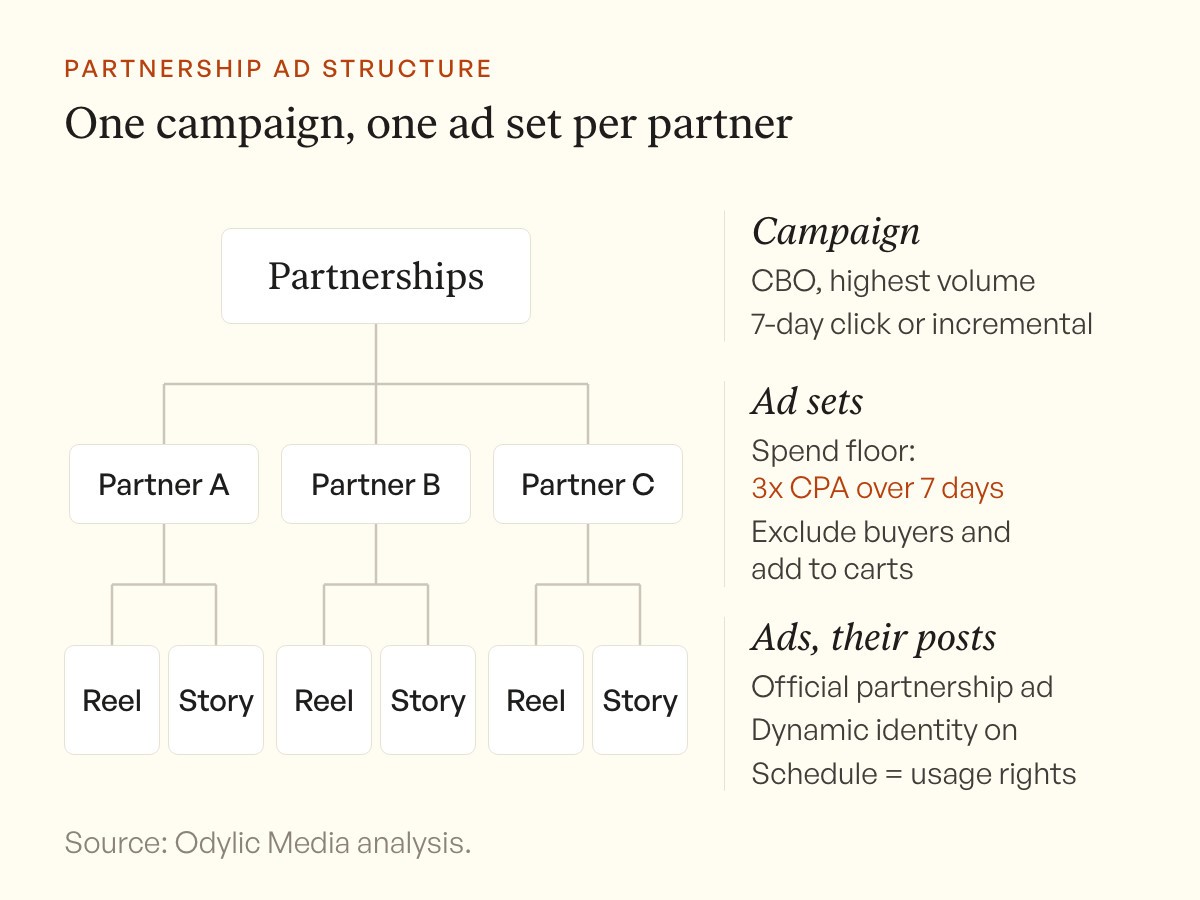
One campaign, one ad set per creator, and a spend floor on each so every creator gets a fair test.
The floor forces Meta to test every creator, even the ones it would skip. It also spreads each creator's test across different days of the week.
That gives a fair shot to creators Meta would not pick up on its own. The floor only works if the rest of the campaign is built around it.
V. Give every creator an ad set and a spend floor
This structure comes from our account experience, not a controlled test. We build it in this order.
1. Build one CBO campaign on highest volume, with the goal set to maximize conversions. In accounts where we ran ABO and CBO side by side, CBO almost always won. Keep the attribution window you already run, so partnership results stay comparable with the rest of the account. Our paper on Meta attribution settings explains why we use 7-day click and incremental.
2. Create one ad set per creator. Ten creators means ten ad sets. Every ad a creator makes for you goes in their own ad set, so you can read and fund each creator on their own.
3. Set a minimum daily spend on each ad set. Take your account CPA, multiply by 3, and divide by 7. A $10 CPA means $30 over 7 days, or about $4.30 a day. A $40 CPA gives about $17 a day. An $80 CPA gives about $34.
4. Check that the floors fit the budget. Add up every creator's floor. The total should sit well below the campaign budget, so CBO still has money to move to winners.
5. Exclude purchasers and add to carts, so spend stays on people who have not bought. Keep targeting broad and adjust only age and gender. That leaves Meta room to find buyers inside the right group.
6. Run each ad as an official partnership ad with dynamic identity on. Use the existing post, so the ad keeps its likes and comments. Connect the Shopify catalog to put products under the creator's content.
7. Set the end date to the creator's usage rights, so the ad stops when your rights to the content end. Turn off heavy creative enhancements, so the ad still looks like the creator's own post.
8. Cut only the clear losers. If a creator is far behind after a full week at the floor, cut it. If an ad is picking up spend and bringing in results, let it run.
9. Judge the campaign on add to carts, new customers and blended results. Platform CPA can run high for a stretch, because partnership ads draw more clicks and fewer sales per click.
10. If your brand has a reach problem, push the campaign colder. Add exclusions for view content, site visitors and 90-day page engagers. Switch attribution to 7-day click, 1-day view and 1-day engaged view. To push harder, move the conversion event up the funnel to view content or reach. Expect platform CPA to rise, and judge the campaign on new customers.
11. Give brand ambassadors their own campaign, usually on ABO. Ambassadors often make dozens of ads around drops and collabs. ABO lets you set the spend for each event yourself instead of letting CBO decide.
Most brands still drop creator content into the main campaign and let Meta pick one or two creators in the first few days. On Monday, move each creator into their own ad set with a spend floor. Then judge them on how long they last, not on week-one CPA. We still do not know why partnership ads last longer, or how much comes from the creative versus the buyer's belief in it.
About this research
The data comes from the Meta ad accounts we manage, June 2024 to September 2026, using the purchases Meta reports. We counted an ad as a partnership ad when Meta marked it with the Paid partnership label. We compared it only with the same brand's other ads from the same months. The longer life held in every brand we could test, but the group of brands is small, so chance could still play a role.

Meta Algorithm
Meta Picks Your Winner in 72 Hours, on One Purchase
At 72 hours, the ad Meta goes on to fund has a median of one purchase, and 37% have zero. More data does not make Meta's pick more profitable.

Meta Algorithm
Meta Does Not Push More Spend to Your Higher-Engagement Ads
Across the brands we manage, engagement explains 0.07% of where Meta puts spend, and a jump in likes buys no extra budget the next day. Meta funds sales.

Creative
A Few Ads Carry Every Meta Account. Your Best Ad Fades in 90 Days
The top 10% of Meta ads take 64% of a typical month's spend, and that is normal. The risk is turnover: your #1 ad fades within three months.