

Account Structure

By
Peter Quadrel
8 min read
Meta overfits your ad account to one buyer. One brand we audited reached 16.7M people at frequency 20. Why Meta ads stop scaling, and how to fix it.
Most brands run Meta the same way. They launch a batch of ads, keep the winners, cut the losers and make more ads like the winners. That is good media buying, and for a long time the numbers prove it.
Then growth stops. You raise the budget and results stay flat. You launch new ads and nothing breaks through.
The usual fix is more copies of the old winner. That pushes more money at people who have already seen your brand and said no.
We see this in almost every account we take over. One brand we audited had reached 16.7 million people at an average frequency of 20. Its media buying was sound. It had simply run out of the one buyer it knew how to find.
So why does a well-run account stop scaling, and what do you do about it?
Meta ads stop scaling because the account overfits to one buyer, and the fix is to train Meta on a new buyer on purpose.
Here is what we found. Testing trains Meta on one buyer. Three forces lock it in. That buyer runs out. New ideas starve, and copies of the winner close the loop.
I. Your testing trains Meta on one buyer
Overfitting is a machine learning term. A model overfits when it tunes so closely to its training data that it stops working on anything new. Google's machine learning course describes it as a model that memorizes its training set and then fails on new data.
A Meta ad account does the same thing. You launch, find winners, kill losers, make more ads like the winners and repeat. Each cycle narrows the account toward one persona, one angle and one format.
The narrowing takes three steps.
In the first step, your team cuts ads at low ROAS. A new account tests many ideas at once. The ones with weak early ROAS get paused, and the winners take the budget. This is correct media buying, and it is where the narrowing starts.
In the second step, Meta cuts ads at low spend. Meta sends spend to the ads that already bring purchases. New ads that get no early spend never collect enough data to prove themselves. The pixel shrinks the pool on its own, and nobody has to pause anything.
In the third step, the pixel locks on one buyer. After enough rounds, the account has one kind of winner. Every new ad is built to look like it, so every new ad reaches the same kind of person.
Each step looks like good management, yet in three steps the account goes from many ideas to one buyer.
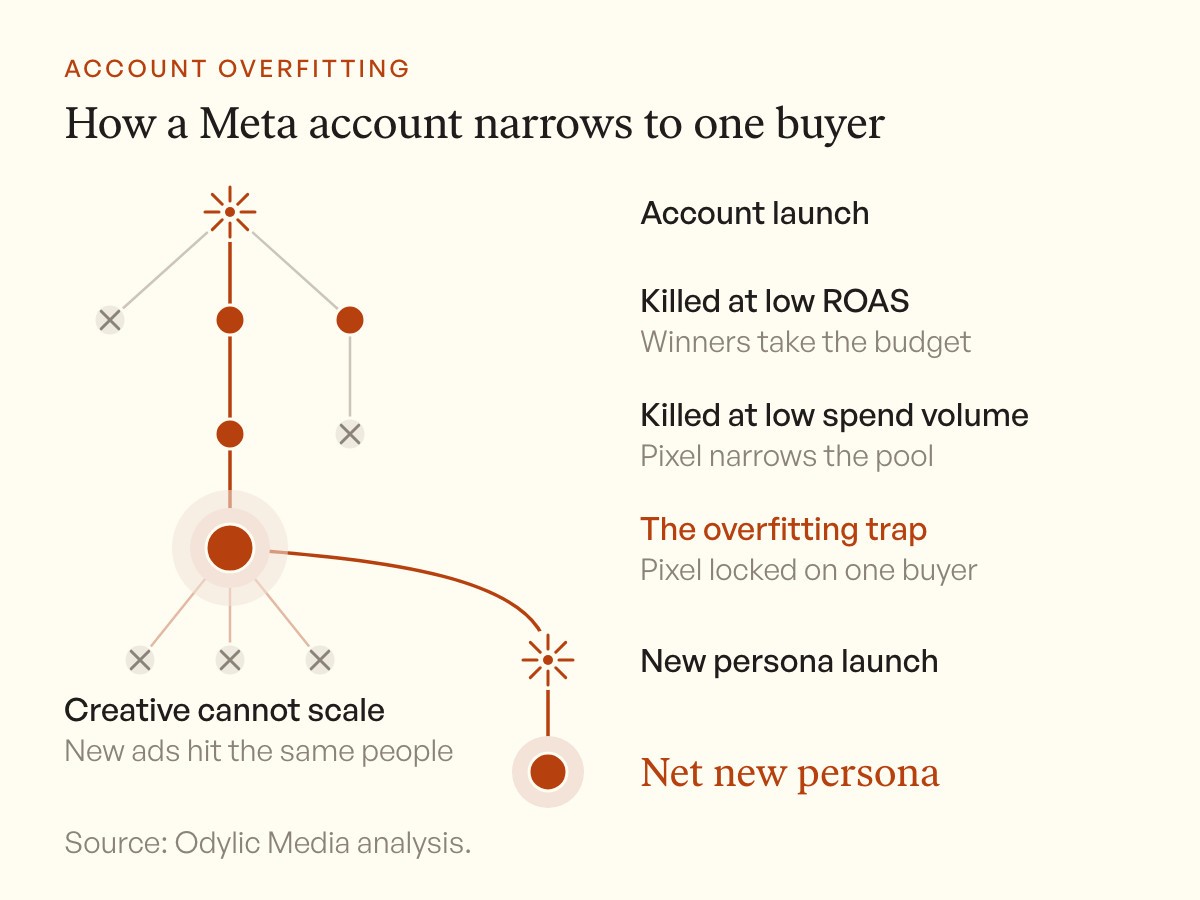
Each round of testing narrows the account, until the only way to grow is to launch a new persona.
This happens at every level of the account: markets, segments, personas, angles and formats.
Most brands read it as a creative problem or a Meta problem. In our experience it is a training problem. The account learned exactly what your team taught it.
So why doesn't the account widen again on its own?
II. Three forces lock the account on that buyer
The narrowing compounds, because three forces push the same way.
The pixel only spends where it has data. Meta funds what has converted before, so a persona it has never seen convert gets no budget.
Your team funds whatever looks like it is working. Budget reviews reward the proven winner, so new ideas get small, short tests.
New concepts fight winners with months of purchase data behind them. A new ad in the same campaign as a proven winner starts with no history at all.
Meta is not wrong to fund the winner. In our study of ad concentration, the top 10% of ads by spend took 62% of spend. Those same ads brought 66% of purchases. Meta spends in line with results.
The problem is that the results only cover the buyer you already trained it on. The pixel keeps finding more of that buyer, year after year, until there are none left at your price.
None of this would matter if that buyer never ran out.
III. That buyer runs out, and the account saturates
The brand from our opening sells sports supplements. It came to us in August 2026 with falling returns. The account had reached 16.7 million people in two years. Its average frequency was 20.1.
Every warning sign pointed the same way. Monthly frequency climbed to 9 to 11 by early 2026.
CTR nearly doubled, to over 1.5%. Over the same stretch, click to purchase fell from 1.40% to 0.59%. People still clicked, but they had already decided not to buy.
The brand cut spend 44% year over year. ROAS still fell, from 0.54 to 0.48. Less money did not buy better results, because the same people were still seeing the ads.
The whole account spoke to four athlete personas. Athlete talking-head video took 47.5% of all spend.
That is overfitting in its plainest form. The buying was sound, but the account only knew how to find one buyer.
We see the same thing in other forms. Another brand came to us having reached five times the size of its entire niche in one year, on one platform. The team had no idea.
A third brand ran the same talking-head format for years. New formats tested worse, so the team stopped testing them. The pixel now has years of data on one style and nothing else.
The obvious way out is to test new ideas. So why don't new ideas break through?
IV. New ideas starve before they get a fair test
New ideas lose inside the account before they get a fair test. Our study of ad volume followed a year of ad launches across the brands we manage.
Doubling the number of launches in a month produced about 47% more winners, not twice as many. The cause was starvation. The more ads a team launched, the more of them got less than $50 in their first 30 days.
Ads that did get fed told a different story. Among them, doubling launches came much closer to doubling winners.
This is how overfitting sets in. A new persona or format often does not lose because it is worse. It loses because it never gets the spend to find out.
The ads that do get fed are usually copies of the old winner. That would be fine if the old winner lasted.
V. Copies of the winner close the loop
Winners do not last. In our concentration study, the top ad kept its spot into the next month only 30% of the time. Its share of spend fell by half the month after its peak, from 16.0% to 7.3%.
So the account needs a new winner every month. In every account where we could split spend by audience, the ad that took the most budget was a new-customer ad. Typically about 95% of its spend went to prospecting.
That matters because the buyer this ad speaks to becomes the buyer the pixel learns next.
When your team makes the next winner by reskinning the old one, the loop tightens. Meta labels that spend as prospecting, because those people have not engaged or bought yet. In our experience they are still the same kind of person, found by the same kind of ad.
The supplement account shows where this ends. Most of its ads were copies, about four for every root concept. One static line was on version 448, and its recent versions got $1 to $8 of spend each. Over a hundred static variants of one concept family returned 0.16 ROAS.
A better copy will not break the loop. Only a new buyer will, and Meta will not find one unless you teach it.
VI. Stop copying the winner and retrain Meta on a new buyer
To fix an overfit account, you have to retrain it on purpose. These are the nine moves we use.
1. Stop new concepts from fighting your winners. Give each new persona its own campaign and its own budget. Fund each new concept to spend at least $50 in its first 30 days. In our volume study, an ad below that line never collected enough data to become a winner.
2. Loosen attribution at the start. Turn on view-through, engaged-view and 7-day click, because the goal is signal. Tighten it 60 to 90 days in. Our paper on Meta attribution settings covers when each window makes sense.
3. Build the signal on purpose. Create a custom event for the new persona's purchases, such as a purchase of the product or bundle that persona buys. Meta's learning phase needs about 50 optimization events a week. If that is not realistic, optimize for add to cart or view content until it is.
4. Keep your ad account and pixel. Starting over throws away all your data and keeps the creative, offers and audiences that caused the narrowing.
5. Suggest the audience, then exclude. Add the new persona as an Advantage+ audience suggestion and leave targeting open. Exclude past buyers and anyone who engaged in the last 180 days, because you want net new people.
6. Lead with partnership ads. Run them with 5 or more creators who are the persona you want to reach. In our experience, nothing builds signal for a new buyer faster. Our paper on partnership ads campaign structure shows how we set them up.
7. Make new creative for new eyes. Your winning formats probably will not carry over, so do not reskin top performers. Stop making variants past the third version of a concept, and protect a share of each week's creative output for the new persona.
8. Tune the offer and landing page to the persona. Use a collab, a free gift opt-in, a sweepstakes or a landing page that speaks their language. Anything that pulls them into your pixel and your email list helps.
9. Reprice acquisition. In our experience a new persona costs 1.5 to 3 times your blended CPA at first, because Meta is training from zero. Across the brands we manage, landing page views fell from 89% to 81% of clicks year over year, so new reach can bring weaker traffic. Give the new persona 30 to 90 days before you judge it against the core account.
The brands in our opening did everything right and still stalled. The brands we see pass 20 and then 50 million dollars a year on Meta retrain three or four times, each on a new persona.
On Monday, launch one new campaign for one new persona, with its own budget. We still cannot see which persona each ad reaches, because Meta does not report it, so judge the retrain by its results.
About this research
This paper draws on the Meta accounts we manage and audit, and on our 2025 to 2026 studies of spend, launches and landing page traffic. We see the narrowing to one buyer through its effects in the account: rising frequency, falling click to purchase and fewer kinds of winning ads. The cost and timing ranges for a new persona come from our own experience, not a controlled test.

Meta Algorithm
Meta Picks Your Winner in 72 Hours, on One Purchase
At 72 hours, the ad Meta goes on to fund has a median of one purchase, and 37% have zero. More data does not make Meta's pick more profitable.

Meta Algorithm
Meta Does Not Push More Spend to Your Higher-Engagement Ads
Across the brands we manage, engagement explains 0.07% of where Meta puts spend, and a jump in likes buys no extra budget the next day. Meta funds sales.

Creative
A Few Ads Carry Every Meta Account. Your Best Ad Fades in 90 Days
The top 10% of Meta ads take 64% of a typical month's spend, and that is normal. The risk is turnover: your #1 ad fades within three months.