

Measurement

By
Peter Quadrel
8 min read
New Meta accounts should start on the loosest attribution setting, even though Meta's own incremental model backs only about 68% of the revenue it reports.
Most brands pick a Meta attribution setting once and never look at it again. They choose the one that sounds most accurate, or they keep whatever the account came with.
That choice costs money, because the setting does more than label your report. It tells Meta which purchases count, and Meta learns from those purchases. A new account on a strict setting gives Meta very little to learn from, so it pays higher prices for longer.
So which setting should you run, and when should you change it?
We compared what Meta reports under each setting with Meta's own model of which sales its ads caused, across the brands we manage. We also checked which settings each account ran during our recent tracking audits.
New accounts should start on the least accurate setting Meta offers, then move to a stricter one once Meta has enough data.
Here is what we found. The setting steers Meta, not just your reports. View credit is its weakest number, but new accounts need it anyway. Click plus engage-through is the right standard for most brands. Incremental suits long journeys. And mixed settings break your reporting.
I. The attribution setting steers Meta, not only your report
The attribution setting on an ad set tells Meta which conversions count. Meta then aims delivery at people likely to convert inside that window, as Jon Loomer's guide to the attribution setting lays out.
So a looser setting does two things. It reports more conversions, and it gives Meta more conversions to learn from. A stricter setting reports fewer and feeds Meta less.
Our paper on how Meta overfits your account makes the same point from another angle. Meta learns from whatever signal you feed it.
What counts as a click also changed this year. In March 2026, Meta stopped counting non-link engagements as clicks. A like, comment, save or share used to count toward click-through attribution. Now only a click on the ad's link does.
Those engagements moved into a new bucket called engage-through. An engage-through conversion is a purchase within one day of a social interaction with the ad, or of an engaged video view. Meta also cut the engaged-view bar from 10 seconds of video to 5 seconds. Jon Loomer's 2026 attribution breakdown covers the details.
In practice, 7-day click now means less than it did in February. To get back to the old meaning, you add 1-day engage-through.
We pick the setting on four inputs. They are your purchase data, your AOV compared with your niche, how long buyers take to decide, and what the business needs now. The industry default answers none of those questions.
That leaves a harder question. How much of what each setting reports did your ads actually cause?
II. View credit is the weakest number Meta reports
Incremental attribution is Meta's model of which purchases the ads caused, as opposed to purchases that would have happened anyway. Meta launched it in April 2025. It is a model, not a holdout test.
We pulled every window Meta reports, including its incremental figure, for each brand and each month. At the typical brand, incremental credited 68% of the revenue that 7-day click plus 1-day view reported. It came in lower at every brand we checked.
The gap held steady over time. Month to month, the share stayed between 64% and 71%.
Incremental landed within about 2% of 7-day click alone. For the typical brand, ROAS read 1.76 on 7-day click plus 1-day view. It fell to 1.45 on 7-day click alone, and to 1.37 on incremental.
The 1-day view layer explains almost the whole gap. The more of a brand's revenue came from views, the bigger its drop on incremental, and the two moved almost in lockstep. At one brand, views carried 85% of reported revenue.
View credit is the weakest piece of the default setting. Meta reports it, and Meta's own model does not stand behind most of it.
So why would a new account run it on purpose?
III. New accounts should run view credit anyway
We run three settings, one for each stage of an account. The loosest setting runs for the first 30 to 90 days, and the other two come after it.
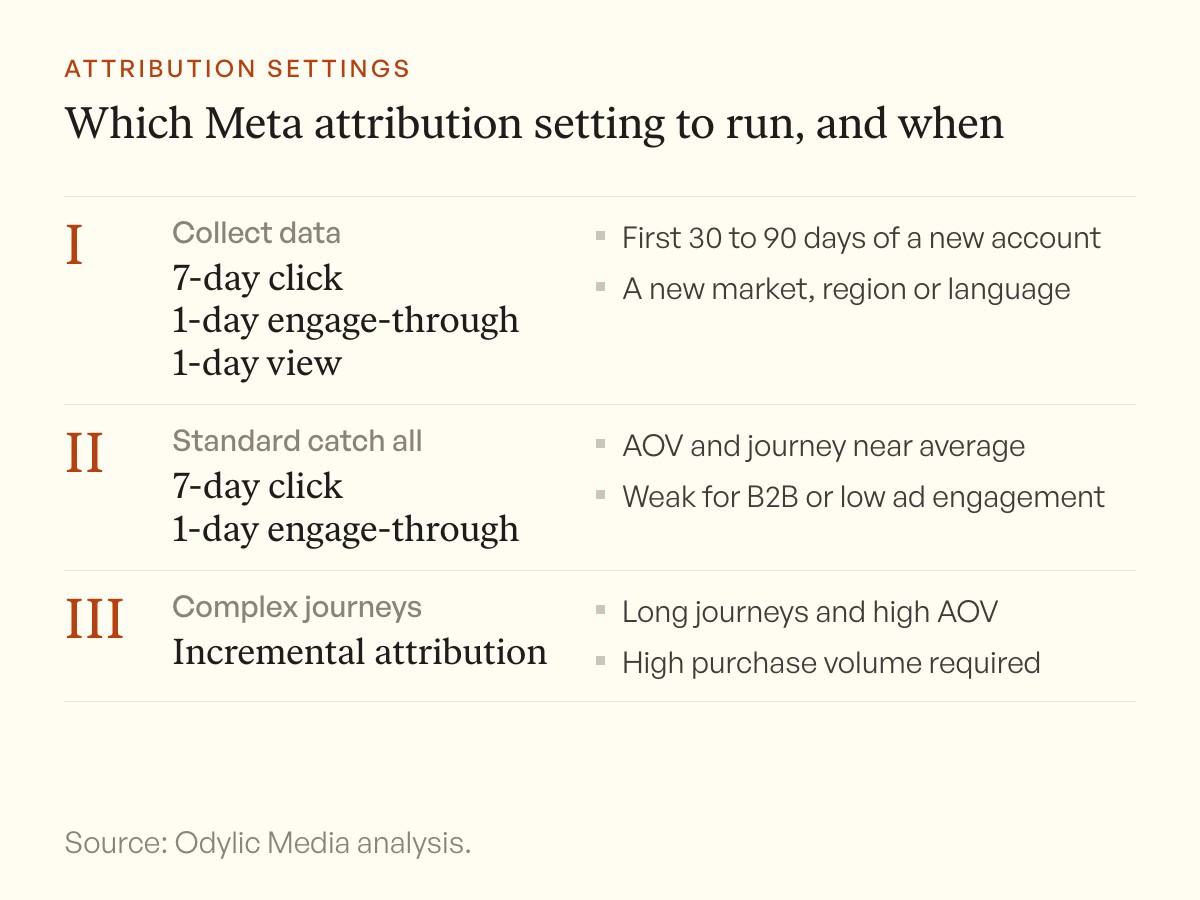
Pick the setting for the stage your account is in: collect data, run the standard, or model a long journey.
The loosest setting is 7-day click, 1-day engage-through, 1-day view. The more you spend per day, the sooner you collect enough data, and the closer to 30 days you can switch.
A new account has almost no purchase history, so Meta has little to learn from. New accounts pay a CPM tax, meaning higher prices per 1,000 impressions, while Meta works out who should see the ads. In our accounts, CPMs come down as the data builds.
Counting views and engagements gives Meta the most conversion events per dollar. Each one tells the delivery system something about who responds. Early on, more signal beats cleaner signal.
Meta does not wait long to act on that signal. Our study of how Meta picks a winning ad in 72 hours shows how little data it needs to decide.
View credit will not match your store revenue, and much of it would have happened anyway. For these first months, that is fine. You are buying impressions, data and, most of all, Meta's favor.
Use the same setting any time a big move resets what Meta knows about your buyer. A clothing brand launching a supplement line is one example. A launch into a new region, in a new language, is another.
So where should the account go once the data is there?
IV. After that, 7-day click plus engage-through is the standard
The standard setting is 7-day click, 1-day engage-through. It is the catch-all default for most brands, and it sits close to what 7-day click meant before March.
You drop view credit, which Meta's own model does not back. You keep engagement on the ad itself as a conversion signal, which gives Meta more to learn from.
This setting also lands close to Meta's incremental figure without its data needs. As we saw above, 7-day click alone sat within about 2% of incremental at the typical brand.
Make the move by duplicating the campaigns onto the standard setting. Do not edit the live ad sets. A duplicate keeps the old and new numbers in separate rows, so you can see the step down in reported ROAS for what it is.
The standard holds up across almost every niche we run. It can perform worse for B2B brands, where buyers rarely like or save an ad before they buy. It also adds little for any account whose ads earn few likes, comments or saves, because the engage-through window then has little to count.
It can still work for high AOV brands with long buying cycles. So when do those brands need something else?
V. Incremental suits long journeys with heavy data
Incremental attribution fits when the customer journey runs long for your niche and you have the purchase volume to feed it.
Long usually means two to three weeks or more from first ad to purchase. It often comes with AOV well above your category average, into the hundreds or thousands of dollars. High-end jewelry, high-end apparel and tech fit this pattern.
It also fits brands that are not expensive in absolute terms but sit far above their own niche average.
Incremental relies on machine learning far more than the other two settings. Meta has to model what would have happened without the ad, and that model needs volume. It needs consistent weekly purchases and steady spend behind it. On thin data, it performs worse.
A tech accessories brand shows what a switch looks like. It moved its campaigns from 7-day click plus 1-day view to incremental at the end of January 2026. In the overlap month, the same audience showed 3.38 ROAS on the old setting. On incremental, it showed 1.41.
Brands that test incremental often see it report about half of what their click settings showed. Some pause the test for that reason alone. Incremental numbers are smaller by design, so judge them against other incremental numbers or against store revenue, not against old click ROAS.
That tech accessories brand had to restate every Meta comparison across the change, and against 2025. None of the three settings helps you if their numbers end up mixed in one report.
VI. Mixed settings break your ROAS reporting
Running two settings in one account is normal during a switch. Leaving them mixed without labels is how reporting breaks.
In our September 2026 tracking audit, almost every Meta account ran more than one attribution setting across its ad sets.
A membership brand had its ad sets spread across four settings. Its two active conversion ad sets sat on different ones.
A cookware brand's year-to-date Meta ROAS read 0.92 on 7-day click alone. It read 1.87 on 7-day click plus 1-day view, and 1.03 on incremental. The choice of setting swung reported revenue by more than the brand's entire Meta spend.
A luxury accessories brand ran its two live campaigns on two different settings, so no one could compare them at all.
A blended ROAS across mixed settings is not a number anyone can act on. So the decision for your account comes down to its stage, and whether every ad set agrees with it.
VII. Match the setting to your account's stage, and label it
1. Check the attribution setting on every active ad set. If you find more than one, write down which campaigns use which.
2. Put new accounts on 7-day click, 1-day engage-through, 1-day view. Keep it for 30 days at high daily spend and up to 90 days at low spend.
3. Use the same setting for any big move, such as a new product category or a new region and language.
4. Move to 7-day click, 1-day engage-through once the data is there. Duplicate the campaigns rather than editing them, and expect reported ROAS to step down.
5. Test incremental only if your journey runs two to three weeks or more and your AOV sits well above your niche. You also need steady weekly purchases. Meta's learning bar of about 50 conversions per ad set per week is a useful floor.
6. Report each setting on its own row. Never average ROAS across settings, and restate history when you switch.
Most brands we meet picked a setting once and never looked back. We treat the setting as a stage instead. It stays loose while Meta learns your buyer, then gets stricter once Meta knows them.
On Monday, open every active ad set and write down its setting. That list tells you which of your ROAS numbers you can compare.
We still do not know how much faster CPMs fall on the loose setting. We see it across new accounts, but we have not run a controlled test of it.
About this research
The comparison of Meta's reported numbers with its incremental model comes from ad accounts we manage or have audited, January to August 2026. The account examples, the three settings and their time frames come from our client and prospect work through September 2026. The main limit is that incremental attribution is Meta's own estimate, not a holdout test, so it can be wrong too.

Meta Algorithm
Meta Picks Your Winner in 72 Hours, on One Purchase
At 72 hours, the ad Meta goes on to fund has a median of one purchase, and 37% have zero. More data does not make Meta's pick more profitable.

Meta Algorithm
Meta Does Not Push More Spend to Your Higher-Engagement Ads
Across the brands we manage, engagement explains 0.07% of where Meta puts spend, and a jump in likes buys no extra budget the next day. Meta funds sales.

Creative
A Few Ads Carry Every Meta Account. Your Best Ad Fades in 90 Days
The top 10% of Meta ads take 64% of a typical month's spend, and that is normal. The risk is turnover: your #1 ad fades within three months.