

Meta Algorithm

By
Peter Quadrel
8 min read
At 72 hours, the ad Meta goes on to fund has a median of one purchase, and 37% have zero. More data does not make Meta's pick more profitable.
Most media buyers treat 50 conversions a week as the bar for a fair creative test. Below that line, the thinking goes, Meta does not have enough data to know which ad is best.
So brands merge ad sets, pool budget and wait. Some Meta reps still tell brands an ad needs 50 conversions before it can move into a main campaign.
That habit costs money. You wait weeks for a verdict that Meta has already reached. Or you overrule Meta on day 2, move budget to an ad that looked better early, and that ad does no better.
We went back through creative launches across the brands we manage to answer one question. How much does Meta know when it picks the ad it will fund, and does more data make that pick more profitable?
The answer is simple. Meta picks its winner in about 72 hours, usually on one purchase or none, and more conversions do not make that pick more profitable.
We found that Meta picks early, picks on almost no sales, picks no more profitably with more data, and picks from predictions.
I. Meta picks the ad it will fund within 72 hours
We looked at launches where three or more new ads went live in the same ad set on the same day. Then we tracked which ad led on spend, day by day.
A few months ago, we showed that the day 3 spend leader ends up as the launch's top spender 67% of the time. This time we asked how long that early lead lasts.
We checked whether the day 2 spend leader was still the top-funded ad in weeks 3 and 4. For this check we used launches from 2024 to 2026.
The day 2 leader was still on top in 64% of launches. Chance would give it 24%.
Waiting does not buy you much. The day 0 leader held 45% of the time. Waiting all the way to day 13 only raised that to 73%.
Most of the signal is in by day 2. The next 11 days add 9 points.
Meta does not lock its pick, but it usually keeps it. In 36% of launches still running in weeks 3 and 4, a different ad took the lead. Half the time, the new leader was the runner-up.
Most of those takeovers came early. 56% happened by day 7, and 79% by day 14.
So Meta makes its choice in about three days. What did the chosen ad have to show for itself at that point?
II. The ad Meta picked had one purchase or none
For this count, we used launches from the DTC brands we manage between January 2025 and June 2026. The funded ad is the ad that got the most spend over days 3 to 13. We counted its purchases at the end of day 2, about 72 hours after launch.
The median funded ad had one purchase. 56% had zero or one.
37% of the ads Meta went on to fund had zero purchases when Meta picked them.
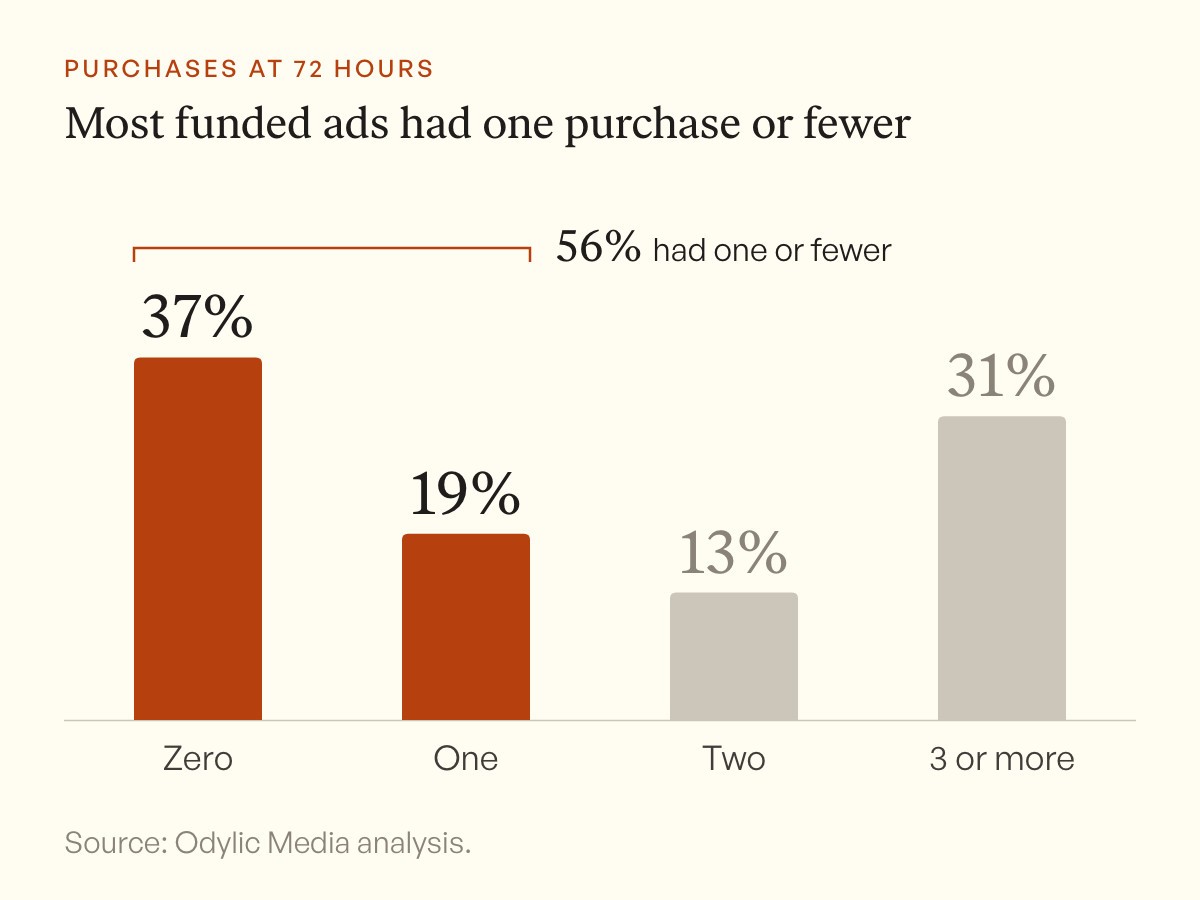
More than half of the ads Meta went on to fund had zero or one purchase when Meta picked them.
The whole batch of new ads had a median of three purchases between them. The ad set was pacing a median of 7 conversions a week over those three days. About 90% of launches ran under 50.
The pattern held in almost every brand. The typical funded ad had two purchases or fewer everywhere except the highest-volume account, and even there it had four.
A fair objection is that a new ad set is in learning by definition, so of course it runs under 50. Launches into existing ad sets tell the same story. They ran under 50 in 78% of cases, at a median of 11.7 conversions a week.
The funded ad's own purchase count did not depend on the age of the ad set either. Meta lists adding a new ad as a significant edit (Meta, Significant edits). So every launch we studied was in learning by Meta's own rules.
If Meta picks on this little, you would expect picks made with more data to be better. So do busier ad sets get better picks?
III. At 7 or 50 conversions a week, the pick is a coin flip on ROAS
If the 50 rule mattered for creative, picks made at 50 or more conversions a week should beat picks made under 10. They did not.
We compared the funded ad with the runner-up on ROAS over days 3 to 29. The runner-up is the ad with the second most spend at 72 hours. We kept only launches with enough purchases to judge, and only pairs where both ads got real spend.
Under 10 conversions a week, Meta's pick beat the runner-up on ROAS 47% of the time. It won 52% of the time at 10 to 25, and 54% at 25 to 50. At 50 or more, it won 47% of the time, the same as under 10.
Across all volumes, the pick won 49.9% of the time. The win rate did not rise as volume rose.
Volume did change one thing. Each doubling of the ad set's conversion pace made the leader 2.1 points more likely to hold its lead. More conversions make Meta more sure of its pick. They do not make the pick more profitable.
Budget did not help either. Once we accounted for conversions, a bigger ad set budget did not make the pick hold more often.
Our earlier 72 hour study found the same split. There, Meta's most-funded ad was the batch's purchase leader 75% of the time. It was the best-ROAS ad only 34% of the time, against 33% by chance.
This does not mean Meta picks badly. The funded ad earned about the same ROAS as the runner-up on about 1.6 times the spend. On lowest-cost bidding, Meta's job is to get the most conversions for the budget, and it does that job. Whether that ad is also your most profitable one is a coin flip.
You cannot beat that coin flip with your own early numbers. Runners-up with better ROAS in days 0 to 2 beat the leader on later ROAS 51% of the time. Runners-up with better early CTR did it 49% of the time, no better than runners-up with no early edge.
Short hot streaks mostly fade. Ads that beat the leader's ROAS over days 3 to 13 did it again over days 14 to 29 only 51% of the time.
So if more volume does not sharpen the pick, what is Meta working from when it chooses on one purchase?
IV. Meta picks from predictions, not from the 50 conversion rule
The 50 conversion rule comes from the learning phase. Meta's help center says an ad set usually leaves learning after about 50 results in a week (Meta, About the learning phase).
That rule describes when an ad set can deliver in a stable way. It says nothing about how Meta splits budget between the ads inside that ad set. Choosing between ads runs on a separate clock.
Meta's help center says that when an ad set has several ads, the system favors the ad likely to get the lowest cost per result. It bases that on predictions of future performance (Meta, About ad delivery).
Every auction scores each ad on its estimated action rate (Meta, About ad auctions). That rate is Meta's estimate of the chance that this person converts from this ad. A new ad gets a score from its first auction.
For new ads with no history, Meta scores the content. Meta's engineers wrote in August 2026 that content features from its models help most in cold start cases such as new ads (Meta Engineering). A 2025 Meta paper, used in live ads ranking, groups new ads with similar existing ads based on their content (Zheng et al.).
So Meta is not deciding on one data point. It draws on the pixel, the account's history, similar ads and the creative itself.
The campaigns around these launches paced a median of 54 conversions a week. The ad set had 7, and the funded ad had one.
The purchases Meta does see still count. When one ad led on purchases in days 0 to 2, Meta went on to fund it 61% of the time, against 25% by chance.
Our signal study found the same thing from the other side. Early ROAS and conversion rate track Meta's spend, while hook rate and CPM do not. That matches our study showing Meta does not chase engagement.
Those early numbers tell Meta which ad will convert. They do not tell you which ad will earn more per dollar. So if you cannot speed up the pick or beat it, where should your time go?
V. Let Meta pick fast, and spend your time on the profit check
The pick happens in about 72 hours whether you wait for 50 or not. Here is how we are changing our creative tests.
1. Stop merging ad sets to hit 50 for creative tests. Picks made under 10 conversions a week beat the runner-up on ROAS as often as picks made at 50 or more. Consolidate only for ad set reasons, such as bid caps or delivery on a large budget.
2. Check the spend split at 72 hours. A leader with 65% or more of day 0 to 2 spend kept the lead through day 13 74% of the time. A leader with under 35% kept it only 34% of the time. This rule held in almost every brand.
3. Recheck the close races on day 7. When the leader holds under 50% of spend, the race is still open. Over half of takeovers happen by day 7, and almost 80% by day 14. Look again on day 7 and once more on day 14.
4. Leave Meta's pick alone when the runner-up shows better early ROAS or CTR. The runner-up's early edge predicted nothing about its later ROAS.
5. Judge the winner by whether account ROAS holds as it scales. Watch blended or new customer ROAS as the funded ad's spend grows. Do not judge it against its runner-up. The profit check is your job, and it lives at the account level.
6. Use a fresh ad set when you want a clean read. Launches into a new ad set gave a pick that held 10 points more often, with 19 points fewer late takeovers. Efficiency was the same.
7. Put your effort into what goes into each batch. Only about three ads per launch get a meaningful share of spend, no matter how many you launch. That fits our study of how few ads carry a Meta account.
You do not need to wait weeks for 50 conversions, because Meta has made its choice by about day 3. On Monday, read the spend split at 72 hours on your latest launch, and judge the winner on account ROAS. We have not yet tested whether better creative makes Meta's pick more profitable, though creative is most of what Meta has to go on.
About this research
The data comes from Meta ad accounts we manage for DTC brands, 2024 to 2026, using Meta's own purchase counts. The funded ad is the ad Meta spent the most on in the ten days after the 72 hour mark. The main limit is that we saw what Meta did, not what a change would cause, and almost every ad set used lowest-cost bidding.

Meta Algorithm
Meta Does Not Push More Spend to Your Higher-Engagement Ads
Across the brands we manage, engagement explains 0.07% of where Meta puts spend, and a jump in likes buys no extra budget the next day. Meta funds sales.

Creative
A Few Ads Carry Every Meta Account. Your Best Ad Fades in 90 Days
The top 10% of Meta ads take 64% of a typical month's spend, and that is normal. The risk is turnover: your #1 ad fades within three months.

Measurement
New Meta Accounts Should Run the Least Accurate Attribution
New Meta accounts should start on the loosest attribution setting, even though Meta's own incremental model backs only about 68% of the revenue it reports.