

Creative

Peter Quadrel
8 min read
Shoppers buy most at 4.0 to 4.7 stars, not 5.0. How to mine your own and competitors' 1-star reviews for Meta ads that answer objections, within the rules.
Most brands handle reviews the same way. The 5-star quotes go into the ads. The 1-star reviews get a polite reply from support, or no reply at all.
That habit costs twice. A wall of perfect praise looks like every other ad in the feed, and buyers do not fully trust it. Meanwhile the complaints that stop the sale sit in the review section, unanswered.
Northwestern's Spiegel Research Center found that purchase likelihood typically peaks at average ratings of 4.0 to 4.7 stars out of 5. It then falls as ratings approach 5.0 (Spiegel Research Center).
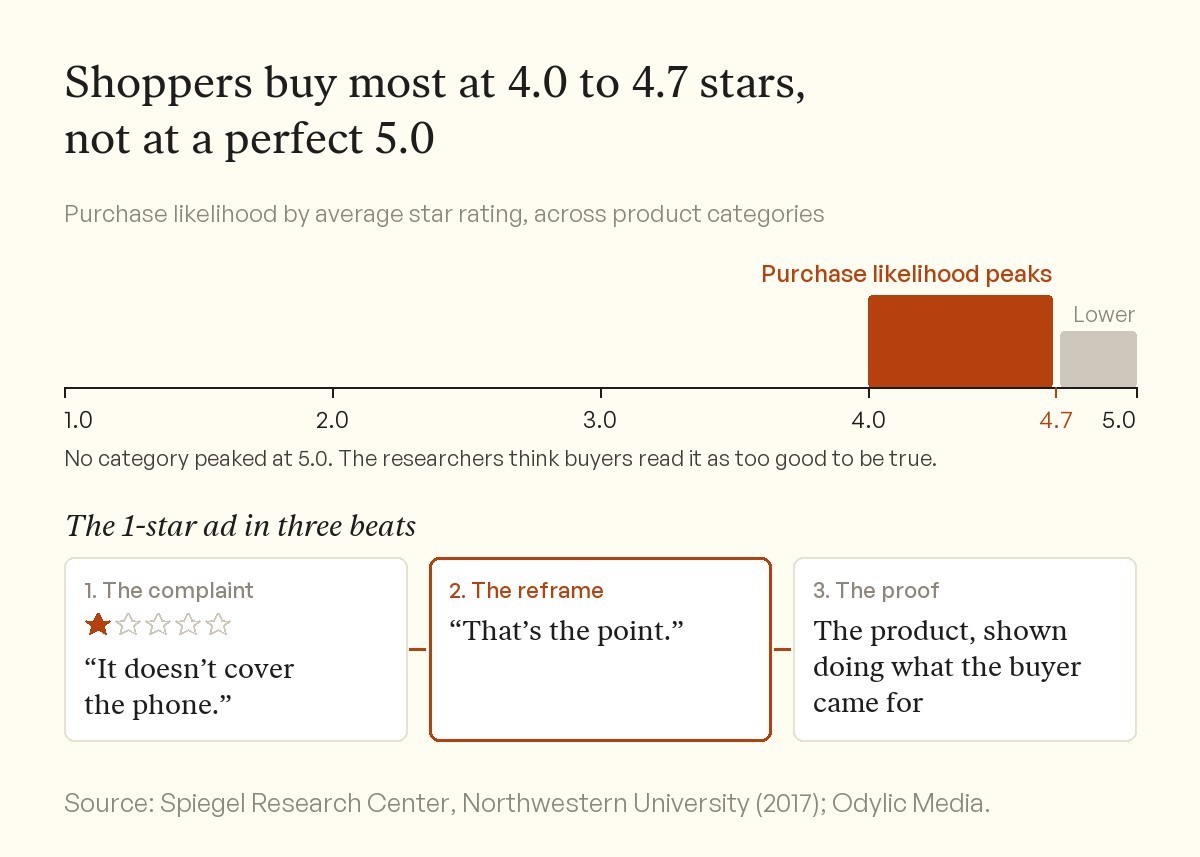
Buyers distrust a perfect score. A 1-star review answered in the same frame gives them the flaw and the reason to buy.
So we asked a simple question. Can the reviews brands hide become the ads that sell?
They can. A good 1-star review names a real objection in the buyer's own words. An ad that answers it does a job a 5-star testimonial cannot.
Here is what we found. Buyers trust imperfect proof more than perfect proof. A small flaw makes an ad more persuasive, as long as the answer comes with it.
Your 1-star reviews, and your competitors', are the best map of objections you have. And Meta, the FTC and the review sites set firm rules on how you can use them.
I. Buyers trust imperfect proof more than perfect proof
No product category in the Spiegel study peaked at 5.0. Products rated 4.7 to 5.0 were less likely to be bought than products rated 4.2 to 4.7.
The researchers think shoppers read a near-perfect score as too good to be true. They add that a negative review is often seen as more credible than a positive one.
Shoppers go looking for the bad news. PowerReviews research cited in the same report found that 82% of shoppers specifically seek out negative reviews.
That is the first reason a 1-star review works in an ad. It is the thing buyers already look for, placed where they cannot miss it.
The second reason is attention. A widely cited review of psychology research concluded that bad is stronger than good. Bad information is processed more thoroughly than good, and bad impressions form faster (Baumeister et al., 2001).
In a feed, that means one red star gets read. A row of five gold stars gets skimmed, because every brand in the category has one.
In our experience, most 5-star testimonial ads look alike. They make the same promise in the same layout, so buyers learn to skip them.
None of this means a negative always helps. So when does a flaw help the sale, and when does it hurt?
II. A small flaw sells when the answer comes with it
The clearest evidence comes from a 2012 study in the Journal of Consumer Research. People liked a product more when a small negative was added to an otherwise positive description (Ein-Gar, Shiv and Tormala).
In one test, people read about hiking boots with good soles and waterproofing. Some were also told the boots came in only two colors. When people were distracted, the boots with the small flaw did better (Stanford GSB).
Two conditions mattered. The effect showed up when people were not thinking hard, and when the negative came after the positives. When people paid close attention, the all-positive version won.
A feed is that low-effort setting. People scroll fast and do not study each ad.
A second study shows why attention matters most for brands that are not yet famous. A negative New York Times review cut sales of books by well-known authors by about 15%. For books by relatively unknown authors, it raised sales by 45%, because it made more people aware the book existed (Berger, Sorensen and Rasmussen).
Most DTC brands are the unknown author. Their hardest job is getting noticed, and a complaint gets noticed. A famous brand gains less from the attention, so the answer has to carry its ad.
Put together, this gives two kinds of 1-star ad.
The flipped complaint leads with a complaint from a buyer the product was never built for. Take a phone case designed to show off the phone. A 1-star review says "It doesn't cover the phone." The ad answers, "That's the point."
For the right buyer, the complaint is the feature. The hook filters out the wrong buyer, and the answer tells the right buyer the product was made for them. The 1-star review becomes a testimonial for everyone who wants what the reviewer did not.
The honest blemish admits a small, true flaw after the benefits. Say a handmade piece takes three weeks to ship. Lead with what the buyer gets, then name the wait and why it exists, in the order the hiking boot study used.
A real defect is neither. If review after review says the product breaks, that is a product problem, and no ad will fix it.
So where do you find the complaints worth flipping?
III. Your 1-star reviews are the best map of objections you have
Every brand already holds a list of the reasons people do not buy. It sits in 1-star and 2-star reviews, the support inbox, post-purchase surveys and the comments under its ads.
Your competitors hold a second list. Their 1-star reviews describe what buyers in your category dislike, in the buyers' own words. Meta's Ad Library shows every active ad they run (Meta, About the Meta Ad Library). The comments under those ads show what their buyers push back on.
We pull every complaint from the last 12 months into one sheet. Then we sort each one into four piles.
1. Wrong-fit complaints. The reviewer wanted something the product was never built to be. These become flipped complaint ads.
2. Small true flaws, such as price, a wait or a learning curve. These become honest blemish ads.
3. Real product problems. These go to the product team, not the creative team.
4. Competitor complaints. These become the objection your product answers, written in your own words. We explain below why you should not quote them.
Then count. Build one ad for every objection that keeps coming up, the same rule as in our jewelry playbook. Brief the most common complaint before the rest.
Watch who wrote each review. In the Spiegel data, verified buyers gave 4.34 stars on average, while reviewers who came on their own gave 3.89. The researchers think unhappy customers are the most likely to make that effort. So weigh a complaint by how often it comes back, not by how angry it sounds.
Each objection is its own angle, not a variant of an old ad. Plan it as a new row on your creative grid. Test it as a static first, because statics are cheap to make, then build the winners out in video.
Place each ad by the job it does. A flipped complaint stops the scroll, so it fits prospecting. An objection answer sits with the proof and risk-reversal ads in each buyer's journey. A competitor complaint invites a side-by-side comparison, which helps close the sale.
Then read the comments on the new ad. Our study of engagement and spend found that comments do little to steer Meta's budget, but they show whether the answer landed. In our experience, people stop asking "what about X" and start saying they get it.
Competitor reviews are the richest source on this list. They also carry the most rules.
IV. Meta, the FTC and review sites set the rules for review ads
Start with the reviews themselves. In the US, the FTC's Consumer Review Rule took effect on October 21, 2024. It bans reviews that misrepresent whether the reviewer's experience was positive or negative, or whether they used the product at all. It also bans fake reviews, including AI-generated ones (FTC).
The FTC is enforcing it. In December 2025 it warned 10 companies that violations can cost up to $53,088 each (FTC).
So the 1-star review in your ad has to be real. Never write a complaint for the hook. The FTC says a review featured in an ad becomes a testimonial (FTC, Questions and answers). Quote it as written and keep a record of where it came from.
Meta can change the words for you. Enhance media text rephrases your text overlay. Text improvements and text generation rework or rewrite your copy. Meta notes that some enhancements may be on by default (Meta, About Advantage+ creative), so turn these off on any ad that quotes a customer.
Your own reviews come with the review site's terms. Trustpilot lets only businesses on its paid plans use its reviews in ads. Each quote needs Trustpilot's name and logo, the review date and the star rating, and it must keep its context. Trustpilot also recommends asking the reviewer's permission (Trustpilot, Legal brand guidelines).
Competitor reviews are for research, not for the ad. Amazon's Conditions of Use do not allow commercial use of its content, and they ban robots and data-mining tools (Amazon, Conditions of Use). Trustpilot's guidelines also forbid making another business's reviews look like yours. Meta rejects or removes ads that may infringe someone else's copyright or trademark (Meta, Intellectual property).
So read competitor reviews by hand, take the objection and write it as a category problem in your own words. "Most cases hide the phone" is your own claim, and you can prove it. A screenshot of a rival's review is an ad waiting to be taken down.
Then check the copy against Meta's Advertising Standards. The reframe must not assert or imply things about the viewer, such as their health, age or finances (Meta, Personal attributes). Write "Gentle enough for sensitive skin," not "Struggling with eczema?"
Health and beauty brands have more rules. Meta bans copy that attacks someone's appearance, body or hygiene, and clickbait in a health or weight context. Before-and-after images are allowed for general cosmetic products in ads aimed at people 18 and over (Meta, Health and wellness).
Finally, answer the complaint in the same frame. Meta measures ad quality in every auction, using signals such as people hiding the ad and checks for withholding information (Meta, About ad auctions). A 1-star hook with no answer reads as clickbait, and Meta says clickbait does not improve ad performance.
This section is our reading of the rules as of October 2026, not legal advice. Have your counsel check any ad that names a competitor.
V. Build one ad for every complaint that keeps coming back
1. Export every 1-star and 2-star review from the last 12 months. Add support tickets, post-purchase survey answers and the comments on your ads.
2. Read your top competitors' 1-star reviews by hand. Do not scrape Amazon, because its terms ban robots. Note the objection, not the wording.
3. Sort every complaint into the four piles: wrong-fit, small true flaw, real problem and competitor complaint.
4. Count each objection, and brief one ad for each of the five that come up most.
5. Write each flipped complaint ad in three beats: the complaint, the reframe and the proof. Keep all three in the same frame.
6. Write each honest blemish ad benefits first and flaw second.
7. Check four things before launch. The review is real and quoted as written, and the reviewer agreed. No competitor name or logo appears, and the copy says nothing about the viewer's personal traits.
8. Turn off Enhance media text, text improvements and text generation on every ad that quotes a review.
9. Launch the new angles as statics. Read the spend split at 72 hours, as in our study of how Meta picks a winner, then build video versions of the winners.
10. Read the comments on each new ad every week. Every new "what about X" is the next brief.
Most brands bury the reviews that explain why people do not buy. The better move is to put those reviews in front of the next buyer, with the answer attached.
On Monday, export your 1-star reviews and count the five complaints that come up most. We have not yet tested 1-star ads against 5-star ads across accounts. The studies above looked at product pages, book sales and lab experiments, not Meta ads.
About this research
This paper draws on the creative we brief and test for the brands we manage. The outside evidence comes from published consumer research and the rules Meta, the FTC, Amazon and Trustpilot publish, read in October 2026. The four piles and the three beats are our working method, not the result of a controlled test.
See what this means for your account.
A complimentary growth session, built around your account and your numbers.

Meta Algorithm
Meta Picks Your Winner in 72 Hours, on One Purchase
At 72 hours, the ad Meta goes on to fund has a median of one purchase, and 37% have zero. More data does not make Meta's pick more profitable.

Meta Algorithm
Meta Does Not Push More Spend to Your Higher-Engagement Ads
Across the brands we manage, engagement explains 0.07% of where Meta puts spend, and a jump in likes buys no extra budget the next day. Meta funds sales.

Creative
A Few Ads Carry Every Meta Account. Your Best Ad Fades in 90 Days
The top 10% of Meta ads take 64% of a typical month's spend, and that is normal. The risk is turnover: your #1 ad fades within three months.