

Account Structure

Peter Quadrel
10 min read
How jewelry brands scale on Meta ads: limited drops feed an evergreen line, about 1 in 3 drops earns a permanent spot, and gifts beat discounts.
Most jewelry brands that stall on Meta look for the fix inside Ads Manager. They test new audiences, new bid strategies and more versions of the winning ad.
In our experience, that is the wrong place to look. Jewelry is one of the few categories where the ads are the easiest piece of the job. The hard problems sit upstream, in the product, the brand and the supply chain.
We have scaled jewelry brands from seven to eight figures over the last six years. The accounts that did not work almost always failed for the same reason. The pieces were not different enough, so the brand ended up competing on price, and nobody wins there unless they own the mines.
So what actually scales a jewelry brand on Meta?
A jewelry brand scales on Meta when limited drops feed an evergreen line. The ads then do what a screen cannot do on its own: show size, weight and shine, and sell the gift.
Here is the playbook in order. The product sets the ceiling, and drops bring the attention while evergreen takes the sales. High CPAs call for simple settings, and the ads have to prove quality. Gifts beat discounts, and creators carry the next stage of growth.
I. The product sets the ceiling before the ads do
Jewelry sits almost entirely on the aesthetic side of ecommerce. People buy it because they like how it looks, with a thin layer of practical reasons such as durability and value retention.
So the look of the product decides how far the account can go. You need a sub-niche inside jewelry that belongs to you: pieces nobody else has, or the classics done noticeably better.
Virgil Abloh, the founder of Off-White and later the men's artistic director at Louis Vuitton, built a career on the second idea. In a 2017 lecture at Harvard, he said he limited himself to editing an existing design by 3 percent (Harvard Gazette).
Jewelry basics work the same way. A plain gold hoop, band or chain becomes desirable when you add one detail that is yours. Shoppers already want the shape, and your detail makes it feel new.
Most brands should do both: classics in their own house style, plus pieces nobody has seen before.
You also need to name the buyer, because "everyone wears jewelry" is not a targeting plan. Pick a segment, such as earthy and spiritual, old money European or young working professionals. Then tune your price points, stories and designs to that buyer. Our paper on how Meta overfits your account shows what happens when an account learns one buyer by accident.
Supply is the other limit. Gold prices swing and materials are hard assets, so production becomes the main constraint for most brands at scale.
Once the product is right, how should the account be built around it?
II. Drops bring the attention, and evergreen takes the sales
For almost every jewelry brand under a $10,000 AOV, the structure that works is evergreen plus drops.
Evergreen holds your accessible price points, your classics and your best sellers, sold all year. Drops are collections of 6 to 12 pieces, made in limited runs and released monthly, quarterly or by season.
The ad budget, the PR and the Instagram attention go behind the drop. The drop sells through, and the traffic it creates buys heavily from the evergreen line underneath it. That line is where most of your market actually shops. When a drop sells out, send buyers to a waitlist instead of reprinting right away.
The lifecycle matters more than the launch. In the jewelry accounts we manage, roughly one in three collections does well enough to keep. Those pieces and their winning ads graduate into evergreen and get more inventory. The rest sell through and get cut.
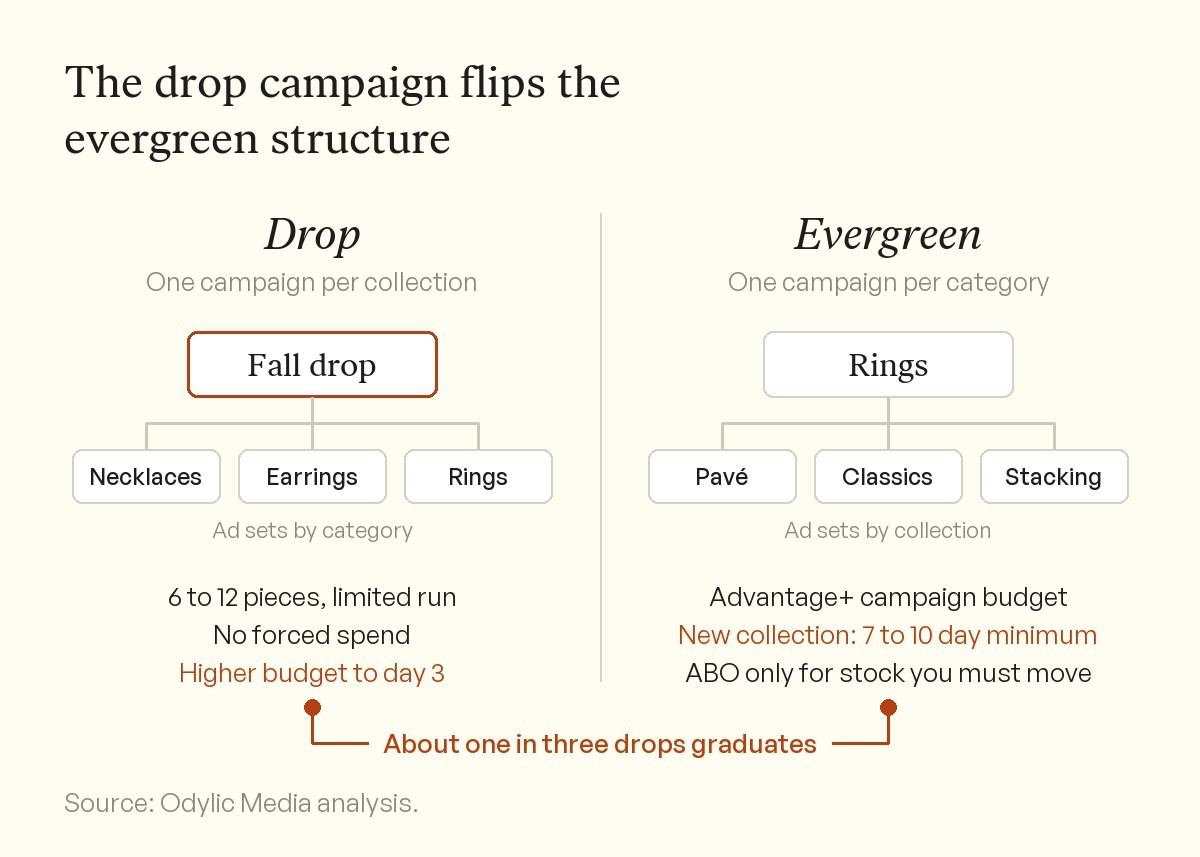
The drop campaign flips the evergreen structure, and the drops that sell move into evergreen.
Even luxury brands should run some version of this cycle, because new pieces give people a reason to pay attention. The two lines need opposite campaign structures.
Evergreen runs one campaign per category, such as rings, necklaces and bracelets, on CBO. Meta now calls CBO Advantage+ campaign budget (Meta for Developers). Each collection gets its own ad set, so a pavé collection sits inside the rings campaign.
Let Meta split the budget unless you have specific stock to move. In that case, switch to ad set budgets (ABO) and force spend where you need it.
When a new collection joins evergreen, give its ad set a minimum spend for 7 to 10 days, then remove it. Meta tries to hit an ad set minimum but does not promise to (Meta for Developers). Check delivery after a few days.
Each drop gets its own campaign, and the logic flips. The campaign is the collection, and the ad sets are the categories inside it, such as necklaces and earrings. Run it on CBO with no forced spend.
Start a drop at a higher budget, then bring it down after about day 3. That timing fits our study of how Meta picks a winning ad in about 72 hours.
With the structure set, the settings underneath it can stay simple. The reason is the size of a jewelry CPA.
III. High jewelry CPAs call for simple settings
Bid on highest volume, the strategy Meta used to call lowest cost. Jewelry CPAs run high, so Meta needs a lot of purchases before it can hit a cost per result goal or a ROAS goal. Until daily spend is large, those goals struggle.
Match attribution to the age of the account. A new account can run 7-day click, 1-day engage-through and 1-day view. Once it has some history, drop the view window. Once it is well established, move to incremental attribution, above all at high AOV.
Meta created the engage-through window in March 2026, when it narrowed click credit to link clicks (Jon Loomer). Our paper on Meta attribution settings covers each step.
Keep Audience Network and Facebook Marketplace out, though Marketplace can work at lower price points. Since August 2026, Meta has been removing placement exclusions from ad sets, account by account (Common Thread). The account controls in Advertising settings can still block both placements everywhere (Meta for Developers).
Keep targeting simple: 18 and up, or 25 and up for higher AOV brands. You can combine regions, because the message travels and images rarely need a split by country.
Keep past buyers out of prospecting, and aim for a returning customer rate of 20 to 35% across the store. In one account we audited that sells jewelry, none of the active ad sets excluded past buyers.
The holidays are the exception. At high price points, email and SMS cannot carry the holiday, because your buyer is buried in messages from every other jewelry brand. So duplicate your creative into a separate campaign that allows existing customers, and track that spend on its own.
Meta has dropped its existing customer budget cap, and its own guide now splits new and existing customers into separate ad sets (Meta for Developers).
Run catalog ads, which Meta now calls Advantage+ catalog ads, in their own campaign with the same exclusions. Jewelry does well when catalog products show under a single image or video. In Ads Manager this is the "Add catalog items" option (Meta for Developers). Meta ended checkout inside Facebook and Instagram Shops in 2025, but these formats still run (PPC Land).
Settings keep the account stable. The creative decides whether anyone buys, and jewelry creative has a problem most categories do not.
IV. Jewelry ads have to show what a screen hides
Brands forget how hard it is to shop for jewelry online. Every image is cropped in, so nobody can tell how big a piece is. Shine and clarity are close to impossible to capture. Weight says the most about quality, and weight does not exist on a screen at all.
So build creative that does that job. Show every size on body, from a tight crop out to arm's length, and put product names and dimensions in text on the image.
Shoot for shine if you sell diamonds or gemstones. Tap the piece on a hard surface on camera, so people can hear the quality.
In the jewelry accounts we manage, statics still bring in new customers at about the same rate as video. Jewelry is one of the last categories where that holds, and it is changing fast. Aim for at least 30% video, and closer to an even split. Slideshow videos, carousels and GIF-style content do unusually well, above all for fine jewelry.
There are only three ways to photograph a piece. You can shoot it on body, as a flat lay on white or texture, or in a still life with objects that set the mood. Keep about two thirds of images on body, in a polished studio or a native UGC style.
Video gives you more room: the design process, orders being packed, founder-led walk-throughs and a polished film for each collection.
Variety is hard when you want one unified look. Let each collection carry its own slight spin on the house style, then vary production level and format underneath it.
Match the ad to the funnel. Upper funnel ads fit as many pieces in frame as they can, such as hand stacks and neck stacks. Send them to a custom collection page built from the exact pieces in the ad. Lower funnel ads narrow to one or two pieces and go to the product page.
Warranty, review and testimonial ads belong at the bottom. Pull your support tickets and post-purchase surveys, and build one ad for every objection that keeps coming up.
Stores solve the same problem, because people can hold the piece. If the quality is there, retail scales further and tends to add new sales. In one jewelry account we manage, most of the growth in store sales came on top of online sales, not out of them. The web pixel could not see any of it.
Creative earns the sale. The calendar decides when the sales come, and jewelry has more selling moments than most categories.
V. Gifts and add-ons sell better than discounts
Jewelry gets selling moments all year: Valentine's Day, Mother's Day, graduation, engagement season, Black Friday and Christmas.
We do not believe in heavy discounts on jewelry, especially at higher price points. A gift with purchase is far stronger. Sonic cleaners, travel boxes, polishing kits and gift cards all work.
Bundles work too. Build the ring and bracelet stack, and give a small break on price.
The play almost nobody runs yet is a care plan, like AppleCare for jewelry. Work with an outside company that handles cleaning, repair and insurance. Sell the plan in the cart as a yearly subscription, and split the revenue.
A care plan is close to pure margin, and it turns a jewelry brand into a recurring revenue business. It makes sense from about a $300 to $500 AOV upward.
Almost every jewelry brand is a heavy gifting brand, and most under-build for it. Give gifting its own campaigns and collection pages. Build pages by recipient, by price (under $300, $500, $1,000 and $2,000) and by occasion, such as graduation or an anniversary.
Zodiac is huge in jewelry, so build those collections even if you do not sell zodiac pieces. Any gifting angle that takes meaningful spend gets its own campaign, or at least its own ad set.
Offers and gifting widen who buys. Creators widen who sees the brand in the first place.
VI. Creators carry the next stage of growth
In our experience, jewelry accounts find their next stage of growth by putting 10 to 50% of spend through whitelisted creators. Meta calls these partnership ads. They run under a creator's handle with a "Paid partnership" label.
Fashion and jewelry are the strongest niches for this, because influencer discovery started in fashion. Creator content goes much further here than in supplements. Even boosting your own posts through creator accounts at the holidays is worth doing.
This is a full program. It takes one or two people to source creators, manage them and keep content moving. Roughly one in five creators works out, even when you choose carefully.
Find people who already look like your buyer and get them pieces early. Then get on-body reviews, lifestyle, unboxing and talking head content from each one. Keep making brand-led content alongside it, because that still performs.
In our study of partnership ads campaign structure, partnership ads stayed live almost twice as long as other ads. They cost about the same per sale.
VII. Fix the product calendar before you touch Ads Manager
1. Give the brand a sub-niche and a named buyer before you scale spend.
2. Release drops of 6 to 12 pieces monthly, quarterly or by season, and send sell-outs to a waitlist.
3. Build evergreen as one campaign per category on Advantage+ campaign budget, with one ad set per collection. Give each new collection a minimum spend for 7 to 10 days.
4. Give each drop its own campaign with category ad sets, no forced spend and a higher budget until about day 3.
5. Move the roughly one in three collections that sell into evergreen, with their winning ads. Cut the rest.
6. Bid on highest volume. Block Audience Network in the account controls, and Marketplace too unless your price points are low. Aim for 20 to 35% returning customers.
7. Keep at least 30% of creative in video and about two thirds of images on body. Show size, dimensions and sound.
8. Replace discounts with gifts with purchase, bundles, gifting pages and, from about a $300 to $500 AOV, a care plan.
9. Put 10 to 50% of spend behind creators, and expect about one in five to work out.
Most stalled jewelry brands we meet start the fix in Ads Manager. On Monday, open the product calendar instead. Check when your next drop lands, and which collection from the previous drop has earned a place in evergreen.
Two things are still open. The care plan is a play we are pushing, not a result we can show yet. And statics may lose their edge in jewelry soon, so check your video share against new customer results every quarter.
About this research
This paper draws on the jewelry accounts we have run and audited over the last six years, from fine jewelry to lower price points. The structure, settings and ratios are rules of thumb from that experience, not results of a controlled test. Meta changes its settings often, so we checked each one named here against Meta's documentation in October 2026.
See what this means for your account.
A complimentary growth session, built around your account and your numbers.

Meta Algorithm
Meta Picks Your Winner in 72 Hours, on One Purchase
At 72 hours, the ad Meta goes on to fund has a median of one purchase, and 37% have zero. More data does not make Meta's pick more profitable.

Meta Algorithm
Meta Does Not Push More Spend to Your Higher-Engagement Ads
Across the brands we manage, engagement explains 0.07% of where Meta puts spend, and a jump in likes buys no extra budget the next day. Meta funds sales.

Creative
A Few Ads Carry Every Meta Account. Your Best Ad Fades in 90 Days
The top 10% of Meta ads take 64% of a typical month's spend, and that is normal. The risk is turnover: your #1 ad fades within three months.