

Meta Algorithm

Peter Quadrel
8 min read
Meta runs natural selection on your ad account. Its pick is the volume leader 75% of the time and the best-ROAS ad 34%. How to grow into new niches.
Most brands grow on Meta with the same loop. They launch a batch of ads, Meta funds a few, and the team makes more ads like the ones Meta funded, round after round.
That loop is natural selection. Biologists say it needs three things: variation, unequal survival and heredity (UC Berkeley, Understanding Evolution).
You supply the variation. Meta decides which ads survive. Your next brief decides what the survivors pass on.
For a while, the loop works. Then spend goes up and results stay flat, because the account has adapted to one kind of buyer and is running out of them. Our paper on how Meta overfits your account to one buyer shows how that happens.
So we asked what biology says about breaking out of that loop.
The answer is simple. Meta selects fast and only for the trait you reward, so an account left alone specializes in one buyer. Growth comes from adaptive radiation, which means new lines of ads built for new buyers.
Here is what we found. Meta selects in days, and for conversions rather than efficiency. Your briefs decide what gets passed on, so the account specializes.
A new line survives only where it stops competing with the winner. And radiation needs an open niche, isolation and room in the budget.
I. Meta selects in days, and only for the trait you reward
Selection pressure is anything that decides which individuals survive and breed. In an ad account, that pressure is Meta's spend.
It acts fast, as our study of how Meta picks a winner in 72 hours found. We looked at launches of three or more new ads into one ad set on the same day. The ad leading on spend at day 3 ended up as the top spender 67% of the time. Chance would give about 20%.
It also acts hard. On day 1, the leading ad was about 15% of the ads in its launch, and it took about 49% of the launch's spend.
In nature, what counts as fit depends on the environment. In 1977, a drought hit Daphne Major in the Galápagos, and the plants made few seeds. The island's medium ground finches fell from about 1,400 birds to a few hundred in just over two years (The Open University).
Only the larger birds with large beaks could crack the hard seeds that were left. Beak size passes from parent to chick, so the drought shaped the next generation too.
Meta's environment is the goal you set. Almost every ad set in our launch study ran on lowest cost bidding, which Meta now calls highest volume (Meta, About bid strategies). There, the fit ad is the one that brings the most conversions.
Among ads that spent at least $100, the ad Meta funded most was the revenue leader 74% of the time. It was the purchase leader 75% of the time.
It was the best ROAS ad only 34% of the time, and the best CPA ad 36% of the time. Chance would give 33%.
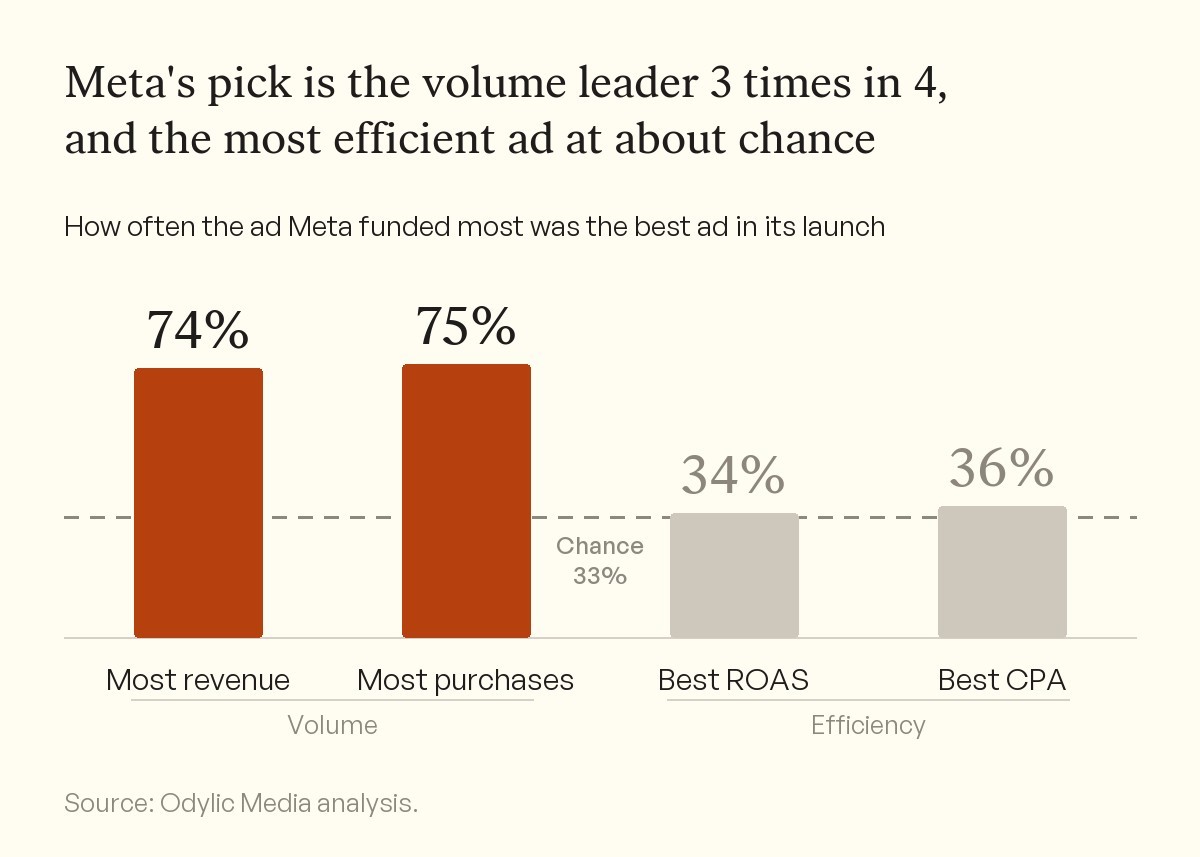
Meta finds the ad that sells the most about three times in four. It finds the most efficient ad about as often as a random pick would.
Meta is doing its job. Its help center says it shows each person the ad most likely to get the lowest cost per optimization event (Meta, About ad delivery). On highest volume, that is the volume ad. Efficiency is a trait you have to select for yourself.
The pressure also runs every night. In May and June 2026, a typical brand we manage moved about 21% of its daily budget to different ads overnight. A year earlier, it moved about 14%. Not every brand saw the rise, and we cannot prove it comes from Meta rather than account setup.
Meta only chooses among the ads it is given. So who decides what the next generation looks like?
II. Your briefs decide what gets passed on, so the account specializes
Natural selection cannot invent anything. UC Berkeley's evolution guide says selection "cannot sense what a species or an individual 'needs'" (UC Berkeley, Misconceptions about evolution). It acts on the variation a population already has.
Meta is the same. It cannot make the ad your next buyer needs, so it funds its best bet among the ads you uploaded.
Heredity in an account runs through two channels. The first is your team. The next brief starts from the winner, with the same persona and hook and a new background or first line.
The second channel is Meta. In December 2025, Meta wrote that its system groups ads that share key visual and thematic attributes. It then shares learning and delivery across the group (Meta, Demystifying creative diversification). Advantage+ audience finds people with signals such as past conversions, pixel data and interactions with previous ads (Meta, About Advantage+ audience).
So a copy of the winner tends to inherit the winner's buyers. Our paper on creative diversity shows how many look-alike ads Meta counts as one.
Generations are short. The median ad in our accounts lived 39 to 45 days. In the median account, the ads that died each month equaled 95% of the ads it launched. That is a new generation about every six weeks, each selected on the same trait and bred from the same parents.
Biologists call this specialization. A specialized population is tuned to one food source. The Daphne finches that survived 1977 were built for hard seeds. An account tuned to one buyer does well until it has reached most of the people like that buyer, at your price.
Our paper on net new reach shows how to see that coming.
A specialized account is not badly run. Its selection is fair, just narrow. So why not drop something different into the same campaign and let Meta choose?
III. A new line survives only where it stops competing with the winner
Daphne Major ran that experiment too. In 1982, a few large ground finches flew in and set up a colony. Their large beaks made cracking big seeds easy.
Then came two years of drought, in 2003 and 2004, and both populations crashed. Medium ground finches with smaller beaks survived better, because they could eat the small seeds the large finches left alone.
In 2004 and 2005, Peter and Rosemary Grant saw the medium ground finch shift toward smaller beaks. The shift carried into the next generation (Nature, 2006). Biologists call this character displacement. Two similar species that compete for the same food evolve away from each other.
A new ad that looks like your winner and chases the same buyers faces the same contest. Its rival has months of purchase data behind it.
Inside one pool of buyers, a few ads win most of the money. In our concentration study, the top 10% of ads took about 64% of the spend that reached new people. They took the same share among engaged people.
More copies do not change that. In our volume study, doubling the ads launched in a month gave about 47% more winners, because more of the extra ads starved.
More copies did not make the account safer either. The month after its busiest launch months, the typical account ran 1.62 ROAS, against 1.64 after its quietest months.
In finch terms, more birds with the same beak do not help when the seeds change. The ad that survives moves to different food: a new buyer, a new offer or a new format.
A new headline on the same image is not a move, because Meta groups it with its parent. So how does an account grow whole new lines?
IV. Radiation needs an open niche, isolation and room in the budget
Darwin's finches are the classic case. Their common ancestor reached the Galápagos about two million years ago. That lineage has since split into 15 recognized species that differ in body size, beak shape, song and feeding (Uppsala University). Some eat seeds, some eat insects and some feed on cactus flowers.
That is adaptive radiation. One ancestor spreads into many species, each fit to a different niche. A niche is the set of foods and conditions a species lives on.
Biologists tie radiation to ecological opportunity, meaning resources that no competitor uses well. A review by Wellborn and Langerhans says opportunity is often high on oceanic islands and in lakes formed after the ice ages (Ecology and Evolution). It can also open when a competitor dies out or a new resource appears.
In models, the review adds, a new type with no predators or competitors has a high chance of taking hold.
In an ad account, the open niche is a buyer you do not reach yet. You reach it with a new persona, a new offer or a new format.
Isolation is the island. A new line needs its own campaign and its own budget, so the winners cannot take its auctions.
Meta says Advantage+ campaign budget may spend most of a campaign's budget on one ad set (Meta, About Advantage+ campaign budget). In our experience, a new persona added as an ad set beside your winner gets very little.
Room in the budget is carrying capacity, the largest population an environment can support.
Your budget sets that limit. In the small and mid-size accounts we studied, real tests leveled off at about 35 new ads per $10,000 of monthly spend. Past about 24 new ads per $10,000, the next ad had less than an even chance of a real test.
Capacity also grows slower than budget. Ten times the budget bought only about 3.6 times the test slots. A bigger budget does not open niches at the same rate.
Each new line starts from zero, so open them on purpose and at a pace your budget can carry. The brands we see grow past eight figures a year on Meta have usually opened a new niche this way three or four times.
V. Breed new lines on purpose, one niche at a time
1. Map your lineage. Tag every live ad by persona, format and offer, as in our paper on creative tracking, then add up last month's spend by tag. If one persona holds most of it, the account has specialized and that persona is your parent line.
2. Choose the goal Meta selects for, and check efficiency yourself. On highest volume, Meta's pick is the volume leader about three times in four and the most efficient ad at about chance. Judge efficiency on account-level new-customer CPA.
3. Give each new niche its own campaign and budget. Never add a new persona as an ad set inside your winner's Advantage+ campaign budget. Our paper on overfitting lays out the full setup.
4. Make each new line move away from its parent. Change the person, the visual and the format, not the headline. Check Meta's Creative diversity label on each new ad set, and treat Low as a sign that Meta may read the line as a copy.
5. Size the radiation to your budget. Plan on about 35 real tests per $10,000 of monthly spend. Open one new niche at a time unless the budget clearly carries more.
6. Keep the parent line breeding. Each month, launch at least as many new ads in your core line as stopped spending in it. The core pays the bills while the new lines grow.
7. Read selection over 7 to 14 days, not one day. About 21% of a typical brand's budget now moves between ads overnight.
8. Judge each new niche against itself. Expect 1.5 to 3 times your blended CPA at first, and give it 30 to 90 days before you compare it with the core.
The loop in our opening is not a mistake. It is natural selection, and it makes an account very good at one buyer. On Monday, tag last month's spend by persona and choose the next niche to open.
We still cannot see which persona each ad reaches, because Meta does not report it. We have also not measured how many niches one account can hold at once.
About this research
The data comes from Meta ad accounts we manage for DTC brands in 2025 and 2026, mostly lower-priced consumer products on highest volume bidding. Meta's pick is the ad it spent the most on in a launch. A real test is a new ad that got at least $50 in its first 30 days. We saw what Meta did, not what a new niche will return.
See what this means for your account.
A complimentary growth session, built around your account and your numbers.

Meta Algorithm
Meta Picks Your Winner in 72 Hours, on One Purchase
At 72 hours, the ad Meta goes on to fund has a median of one purchase, and 37% have zero. More data does not make Meta's pick more profitable.

Meta Algorithm
Meta Does Not Push More Spend to Your Higher-Engagement Ads
Across the brands we manage, engagement explains 0.07% of where Meta puts spend, and a jump in likes buys no extra budget the next day. Meta funds sales.

Creative
A Few Ads Carry Every Meta Account. Your Best Ad Fades in 90 Days
The top 10% of Meta ads take 64% of a typical month's spend, and that is normal. The risk is turnover: your #1 ad fades within three months.